


60k+
Students awarded Unicaf scholarships worldwide
$100M+
Total scholarship value awarded
158
Countries in the student network
82%
My scholarship — 2026 milestone
The phone call I almost didn’t take
Pauline called me several times. I did not pick up. The number was unfamiliar, I was busy, I had the standard suspicion most of us carry toward unsolicited calls about educational opportunities. She called again. And again. Eventually, I answered.
Pauline introduced herself as my student advisor at Unicaf. She told me I had made the cut for the scholarship. Not “you may qualify” or “you could be eligible” — she said I had made the cut.
She then walked me through exactly what I needed to submit for my specific profile:
- an updated CV,
- a cover letter,
- my undergraduate degree certificate,
- and three professional references.
Not a generic list. Mine. My references were Mr. Guled from Aboosto Group of Companies, Victor from Madavi, and Dr. Eugene Reywa Peywa from Spicas Nursing Home — people who had seen me work at close range.
I want you to sit with that for a moment. Pauline had read my application. She knew what was specific to my case. She called until I picked up.
That is not automated onboarding.
That is a person choosing to be genuinely useful.

Before you click Apply: what Unicaf actually is
Unicaf is not a university — it is the Platinum Partner delivery organisation that handles recruitment, admissions, enrolment and learner support for a consortium of British universities, including the University of East London.
When you study through Unicaf, your degree is awarded by UEL, not by Unicaf.
The certificate you graduate with — the one you carry across the stage at graduation in London — bears UEL’s name and seal.
This distinction matters particularly when fact-checking. Google Trends shows “University of East London” searches have risen 500% globally in recent years, and “unicaf scholarship legit” and “unicaf scholarship fake” are among the fastest-rising associated queries.
People are finding this route and running the same credibility checks I did.
The official partnership page is here:
Why UEL — and why a UK university at all
The question I was asked most, even before people asked about the application process, was this: why go the route of a UK university? Kenya has universities.
Good ones.
So why look that far?
The honest answer has several layers.
The first is the programme itself.
The MSc Business Psychology at UEL is accredited by the Association for Business Psychology (ABP) — a professional body recognition that is not replicated anywhere in the local Kenyan postgraduate landscape for this specific discipline.
The course is taught entirely by practising business psychologists, steers away from exams in favour of real-world professional assessments, and is structured around weekends so working professionals can manage it without stepping away from their careers. I looked.
There is no comparable programme in Kenya — not at this level of specialisation, not with that professional accreditation attached, not designed with the working professional explicitly in mind.
The second layer is about what a ranking actually tells you. There is a tendency to dismiss mid-table UK universities with the same scepticism we apply to inflated local ones — and I understand that instinct. But the Guardian University Guide ranked UEL 33rd out of 123 UK universities, placing it in the top six universities in London. What I found more persuasive than the number, though, was what that particular table measures.
The Guardian ranking prioritises teaching quality, student support, assessment feedback, continuation rates, and a metric called “Value Added” — a measure of how effectively a university helps students exceed expectations relative to where they started. UEL ranks among the top UK institutions on that measure.
For an international student investing real money and real time in a postgraduate qualification, a university that is built around helping you achieve rather than around how selective it looks on paper is exactly the right kind of institution to choose.
The third layer is outcomes. UEL describes itself as a careers-first university, and the data supports that framing — it sits in the top 10% of the UK higher education sector for employment-related outcomes and was named University of the Year for Teaching Quality by the Times and Sunday Times Good University Guide 2025.
The MSc Business Psychology programme has placed graduates at Google, Amazon, Deloitte, Vodafone, the RAF, the Ministry of Defence and a range of occupational psychology consultancies.
That is a graduate network, a career track record, and a professional legitimacy that does not yet exist in the same concentrated form through a Kenyan institution offering comparable content.
None of this is a dismissal of local universities. Many Kenyan institutions are doing serious work. It is, rather, an honest accounting of what this specific qualification required — and why, for this programme at this stage of my career, a British university was the right answer to the question.
The Unicaf partnership that made it financially accessible was the final piece. But the decision of which UK university was made long before I started the application.

The process, as it actually happened
A note before we begin:
Unicaf’s admission and scholarship process is responsive to individual profiles. What I describe here is my experience — the documents requested, the scholarship offered, and the timeline I navigated.
Your process will be shaped by your academic background, your region, and the intake available at the time you apply.
What will not change is that a real human will call you, and that call is worth taking.
1. Register — then answer the advisor’s call
Your first interaction is through the registration form on unicaf.org. A student advisor contacts you shortly after. Do not do what I did. Answer the first call. Pauline’s call was the most useful conversation in my entire application process — she gave me a clear list of next steps and stayed on the line while I wrote them down.
02. Submit your specific documents — not a generic list
Pauline told me what my profile needed: an updated CV, a cover letter, my degree certificate, and three named references — Guled, Victor, and Eugene. Requirements are profile-specific. Choose references who can triangulate a picture of your professional character from different angles. They are not a formality. The committee reads them.
03. Do your due diligence — thoroughly and internationally
Every university admission involves money, and money deserves rigorous verification. I talked to friends. I received an anonymous tip to open a OneKitty fund — a pooled community contribution towards my tuition — to receive support from people in my network. Before any money moved, I brought in my best friend and sister, Kaye. Kaye did not limit her research to what was circulating on Kenyan social media. She went wider — checking what people in Canada were saying about Unicaf, UEL, and British online degrees. We took our time. When we both felt comfortable with what we found, we moved.
04. Pay the application fee — through whatever means you have
The application fee was £35. We paid it through OneKitty — the fund that friends and well-wishers had contributed to for exactly this kind of moment. Thirty-five pounds is not nothing. It is also not nothing to have people in your circle who put money toward your education before it has produced anything. I did not take that lightly.
05. Receive and accept your offer — then face the payment milestone
I received an offer letter for an 80% scholarship with a payment plan. I accepted. The next milestone was a minimum payment of 30,000 KES by 30th March. I raised 15,000. Not 30,000 — fifteen hundred shillings. I was already making peace with trying again next year when I spoke to Pauline again.
I raised 15,000 shillings of a 30,000 shilling deadline. And I stayed in the conversation anyway. That, it turns out, was the whole job.”
06. The information that changed the stakes
Pauline told me something I had not considered: the 80% scholarship was a 2026 milestone offer. It was not guaranteed to be available the following year — the scholarship structure for future cohorts could look different. She was not pressuring me; she was informing me. The window I was standing in was real and it was closing. I held that information and did not know what to do with it.
07. The call from the scholarship committee
A member of the scholarship committee called to congratulate me for making the cut — and told me they were increasing the scholarship to 82% with a revised payment plan. I accepted without hesitation. There are moments when an institution reviews your circumstances and chooses to bend the rules in the direction of kindness rather than enforce them as written. This was one of those moments. I am still thinking about what that means.
08. Enrolment confirmed — the real work begins
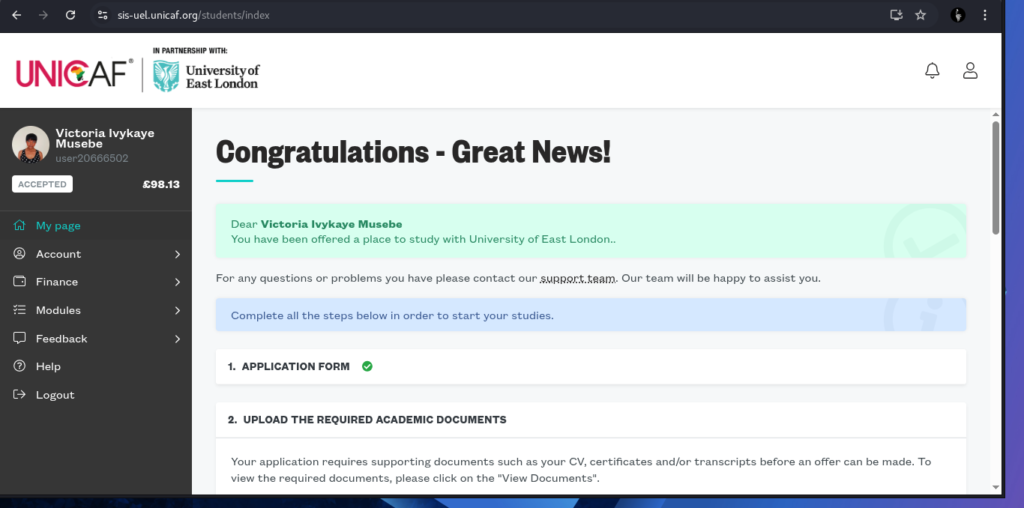
I am now enrolled at the University of East London. The platform is live. My modules are visible. School begins in May. I am setting up what I am calling my home school — a physical and deliberate study environment built around serious learning, not distraction. The application is complete. The education is just starting.
Official Payment Plan — MSc Business Psychology · UEL via Unicaf · 2026 Scholarship
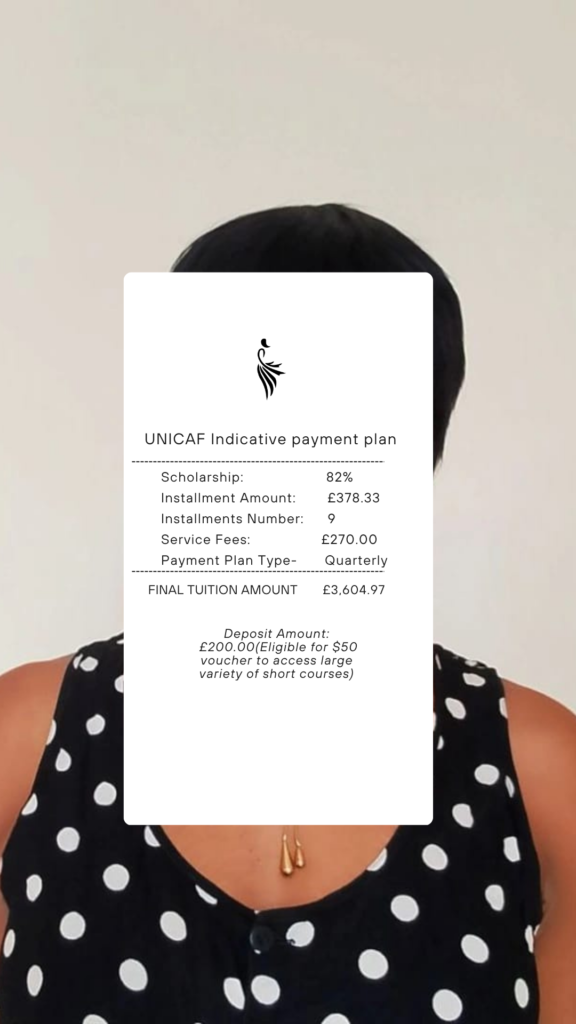
Subject to approval by the Scholarship Committee. 2026 intake pricing.
Source: official Unicaf payment plan communication received by Victoria Ivykaye Musebe.
On kindness as a business philosophy
There is a book I have been meaning to read — the physicist Carlo Rovelli’s collection of essays titled There Are Places in the World Where Rules Are Less Important Than Kindness.
The title landed differently after this process.
UNICAF had rules.
A payment deadline I had missed.
A threshold I had not reached.
They also had information about my circumstances.
And the scholarship committee chose to call and offer more, not less.
That is not nothing.
In an era when institutions typically optimise for efficiency and risk management, a call that says “we are going to increase your scholarship” is a choice.
It is also, I would argue, good business — because the student who is treated with that quality of human attention does not forget it, and they do not stay quiet about it.
Come Be Our Classmate
Study with me. Do assignments with me. Let’s travel to the UK for Graduation!
I am enrolled in the Msc. Business Psychology programme at the University of East London, starting April 2026. If you have been sitting on this decision — use my referral link to apply. Your scholarship eligibility is not affected.
Google Trends shows “unicaf scholarship legit,” “unicaf scholarship fake” and “is unicaf scholarship real” among the fastest-rising associated queries. I ran all of them. Kaye ran them internationally.
The answer:
Unicaf is a legitimate, accredited delivery partner. The degree is from UEL — a British university founded in 1898. Verify this yourself. Do not let unverified suspicion stop you from investigating something that is worth investigating.
Homeschooling Yourself vs. Enrolling:
The Real Difference Between Self-Directed Learning and a Structured Degree in 2026
Philosophical and practical — what structure gives you that self-learning cannot, and why MSc Business Psychology is the credential gap that Kenya’s HR profession has left entirely open.

Before we enrolled in anything, we were already learning.
That is an important place to start. We had been learning for years — from books, from conversations with people who had been where we wanted to go, from the friction of trying things and failing and trying again.
We had built frameworks in our minds about education, about how people develop, about what it would take to transform learning from something that happens to children into something communities consciously construct for themselves. We once wanted to build a school in Uganda.
We still hold the dream at Nnalolile Projects.
That impulse told us to believe in structure.
But our practice taught us self-direction for a long time.
So when we finally enrolled, we were not choosing learning over ignorance. We were choosing one kind of learning over another. That is a more complicated decision than most of the discourse around it suggests.
What self-directed learning actually is
Real self-directed learning — not the motivational-poster version — is about taking responsibility for identifying what you do not know, finding ways to address that gap, evaluating whether your approach is working, and iterating.
It requires metacognition. It requires honesty about your own blind spots. And it requires a level of intellectual self-trust that most of us spend years building imperfectly.
“Self-directed learning is the most powerful form of education available to an adult. It is also the one most likely to be abandoned before it produces anything durable.”
What structure gives you
External accountability:
A submission deadline on Tuesday that does not move because you are tired on Monday. A structured sequence of difficulty that stops you from learning only what you find interesting and forces you into the terrain that exposes your gaps.
A credentialed outcome that opens doors self-directed learning cannot reliably open — because the labour market still runs on certificates.
And an intellectual community:
people from 158 countries working through the same material from entirely different contexts.
What does the self-directed learning gives you?
Freedom.
The freedom to follow a thread wherever it leads, to set your own standards, to learn at the pace the material actually requires rather than the pace a syllabus allows.
And relevance speed — a self-directed learner in a fast-moving field can often be more current than someone completing a module designed two years ago.
Both are real.
Neither cancels the other.

Why we chose MSc Business Psychology — and the market gap nobody in Kenya is filling
The MSc Business Psychology is offered by the University of East London and is delivered to students across Africa through its partnership with Unicaf.
This partnership provides a primary pathway for students on the continent to earn this specific UEL qualification at a subsidized cost without relocating to the UK; however, other UK universities also offer similar accredited Business Psychology degrees via distance learning to African students.
That exclusivity is worth examining carefully, because it isn’t just a marketing choice—it highlights a genuine gap in the professional education landscape.
While other UK institutions offer distance learning, the UEL and Unicaf partnership creates a specific “middle ground” that didn’t previously exist:
a prestigious British curriculum delivered through a framework specifically optimized for the unique infrastructure and financial realities of the African continent.
The Psychology Credential Gap
Kenya’s HR profession is dominated by CHRP (Chartered Human Resource Professional) and MBA holders. Fewer than 3% of practising HR professionals hold any psychology-specialised qualification.
Business Psychology is applied behavioural science — it covers
- psychometric assessment,
- motivation theory,
- organisational behaviour,
- and people analytics in ways that a management degree does not reach.


The Mental Health at Work Gap
Kenya’s Mental Health Amendment Act (2022) has placed workplace wellbeing on the legislative agenda. Organisations now have compliance obligations around employee mental health — but almost no internal capacity to meet them.
Business Psychology graduates are uniquely equipped to
- lead Employee Assistance Programmes,
- mental health-informed HR policies,
- and psychologically safe culture design.
The Silicon Savannah Talent Gap
As Kenya positions itself as Africa’s technology and financial services hub, multinational companies operating here require sophisticated talent strategies:
- psychometric-based hiring,
- high-performance culture design,
- leadership development grounded in behavioural science.
The demand for these capabilities is outpacing the supply of qualified practitioners.
There are almost no Business Psychology graduates in East Africa to fill this demand.


The Evidence-Based HR Gap
Traditional HR practice in Kenya relies heavily on precedent, compliance, and instinct.
People analytics — the use of data and psychological frameworks to predict performance, model retention, and design interventions — is being adopted rapidly by organisations globally.
Business Psychology trains practitioners in the data interpretation and psychometric tools that evidence-based HR requires.
The Evidence-Based HR Gap
The Independent Consulting Gap
A Business Psychology qualification creates an independent practice path that most HR credentials do not.
Organisational development consulting, executive coaching, psychometric assessment services, and leadership programme design are under-served professional niches in Kenya.
A UK-accredited master’s in this discipline is the entry credential for credible practice.


The ESG Reporting Gap
Multinational companies in Kenya are increasingly required to produce environmental, social, and governance (ESG) reports that include people metrics:
- employee wellbeing scores,
- culture health indicators,
- equity measures.
Business Psychology provides the frameworks and assessment tools to generate these metrics credibly — a function that currently falls to no one clearly in most Kenyan organisations.
We chose MSc Business Psychology because we have spent years watching the space between how people work and how organisations manage them get wider rather than narrower.
We have seen what happens when that gap goes unfilled — disengagement, attrition, capable people managed by frameworks designed for a different era. We want to be the practitioner with both the credential and the methodology to close it.
The fact that this is the only programme of its kind available in Africa through a British university is not a coincidence we’re ignoring. It is, in career terms, a moat.
And we intend to build on it.
UEL MSc Business Psychology · Only in Africa Through Unicaf
Study This With Me
If the market gap analysis above resonates — if you are in HR, consulting, organisational development, or leadership and you have been looking for a programme that meets the actual needs of the African professional context — this is it.
Apply using Nnalolile’s referral link. We can study together, compare notes, and walk across the same graduation stage in London, UK
The honest conclusion
Self-directed learning and formal enrolment are not substitutes. They are instruments for different problems. If you need credentials, community, and a structured forcing function: enrol. If you are building skills in a fast-moving space and have the discipline to direct yourself: self-direct.
Most people, if they are honest, need both. Use institutional learning to build the foundational architecture.
Self-direct everything built on top of it. The degree gives you a floor. What you build above it is entirely your own. For us, returning to school is not an admission that the years of self-directed learning were insufficient. It is a recognition that some things require the kind of external structure we are no longer willing to try to manufacture for myself.
Wehave the curiosity.
We have the motivation. What I am buying is the container.
Dear Kenyan Employer: Your Best Employee Is Quietly Looking for a Way Out. Here’s What You Can Do.
An open letter on talent attrition, the invisible cost of losing good people, and why upskilling through online degrees is the retention strategy Kenyan SMEs have not tried yet.

Dear Kenyan Employer,
Let’s talk about someone you probably already know.
They are reliable — the kind of reliable that means they have never missed a deadline without warning you in advance. They solve problems before you have finished explaining them. Junior staff go to them first when something breaks.
In meetings, their contributions are the ones people quietly write down.
They have been with you for three, maybe four years. Their salary sits in the same band it has occupied since their last review. Their job description has not changed in eighteen months, though the actual scope has expanded considerably.
And tonight — or last Thursday, or next Tuesday — they opened a laptop and started reading about online degrees.
— Victoria Ivykaye Musebe
What attrition actually looks like before it happens
The narrative about losing good employees focuses on resignation letters and exit interviews. By the time either arrives, the decision was made months ago.
The real moment of departure is invisible and mundane: a quiet afternoon when someone realises their ceiling is lower than their potential.
That no one is investing in who they might become.
They do not storm out.
They become careful.
They stop volunteering ideas they no longer trust will be acted on.
They are still professional, still competent — but they are quietly building an exit ramp.
“The employee who stops asking questions is not the one who has run out of questions. They are the one who has stopped believing the answers will come.”
Why Kenyan SMEs find this particularly painful
Most Kenyan small and medium enterprises operate on margins that do not accommodate generous professional development budgets.
There is also the documented fear:
invest in training someone, and they take that training to a competitor. These are real concerns, not excuses.
But they are worth examining, because the alternative — doing nothing — carries its own cost, one that accrues slowly and invisibly.
Research on employee replacement costs consistently estimates the total expense at between 50% and 200% of the departing employee’s annual salary, depending on role complexity. There is the productivity gap while the role sits unfilled.
The ramp-up period of three to six months for the replacement.
The institutional knowledge that walks out — client relationships, undocumented processes, team dynamics. And the signal effect on everyone who watches them go.
For your most capable mid-level staff, the lower end of that estimate alone is almost certainly more than you would have spent on structured upskilling over the same period.

What upskilling looks like in 2026 — concretely
Online degree programmes through platforms like Unicaf have changed the cost and accessibility calculation for professional education in Africa.
An employee pursuing a part-time master’s at the University of East London pays a quarterly instalment — not a lump sum.
After an 82% scholarship, the total cost is £3,604.97 spread over nine quarterly payments of £378.33. They study asynchronously, meaning the work does not compete with office hours.
They bring back behavioural science frameworks, research skills, and a broader professional network.
And critically — they do this while remaining in your employ, which is when the benefit begins accruing to you.
A support arrangement that helps cover part of that cost is a retention mechanism.
It is also a signal:
we see what you are capable of, and we are making a deliberate investment in it.
That signal does more for loyalty than a salary review, because salary is compensation for what someone has already done. Education investment is an expression of belief in what they might do next.
A practical starting point — if budget is the constraint
One hour per week of protected professional development time. A policy that covers application fees for relevant courses. A career trajectory conversation at every annual review, not just a salary discussion. An agreement to support quarterly instalments in exchange for a return-of-service commitment. The signal matters as much as the budget.
Start with the signal.
The conversation you have not had yet
Find the person in your organisation who resembles the employee I described at the opening of this letter.
Have the conversation before they have it somewhere else.
Ask them what they want to be doing in three years.
Ask what skills they feel they are missing.
You may find the answer is simpler than you expected.
But you will have made it clear that the question exists — that there is space in your organisation for someone to grow into a larger version of themselves without leaving to do it.
You built something that runs on the commitment of people who choose your organisation every day over alternatives.
That choice renews — or doesn’t — every time someone closes their laptop and decides whether the version of themselves they want to become is likely to exist here.
Your best employee is deciding that right now.
The Unicaf / UEL Path Is Open Right Now
Whether you are the employee building your exit ramp, or the employer trying to build a better destination —the MSc Business Psychology at University of East London through Unicaf is a concrete, affordable, internationally-credentialed option available right now.
Let’s build the future of African professional practice together.
Leave a Reply