
The Fabric Edition · We Look. We Listen. We Learn.
Cloth is not just cloth. In Africa, it speaks before you do. The definitive guide to kitenge — its history, its geography, its power, and what 6 yards of it can build.
“Man is the creature who does not know what to desire, and he turns to others in order to make up his mind. We desire what others desire because we imitate their desires.”
— René Girard ·
We Look. We Listen. We Learn.
The Question
What Is a Kitenge Fabric?
Let’s set the scene: you’re at a wedding in Nairobi. A funeral in Lagos. A graduation in Accra. A night out in Kinshasa. A rooftop in the London diaspora. What do all these moments have in common? Someone, somewhere, is wearing a stunning piece of printed African fabric — and heads are turning.
But not all African print fabrics are the same. That electric bolt of color your Ugandan auntie wraps at the market?
Kitenge
The strip-woven cloth your Ghanaian cousin wore to graduation? Kente.
The wax-print blouse your Lagos bestie wore to Fashion Week?
Ankara
The light cotton piece with a Swahili proverb your grandmother ties at her waist?
Kanga.
This is your no-fluff, culturally-rooted guide to the fabrics of Africa — with kitenge firmly at the center of the conversation.
Kitenge is not a starting point. It’s a whole world.”
Kitenge (pronounced kee-TEN-gay) is a brightly colored, printed cotton fabric beloved across East Africa, Central Africa, and parts of Southern Africa.
Typically 100% cotton, it’s known for its bold geometric and floral patterns, vibrant color combinations, and a slightly thicker weight that gives it excellent structure and drape — making it the fabric of choice for tailors, fashion designers, and anyone who wants their cloth to carry intention.
Technically, kitenge uses an industrialized version of the batik printing technique — designs are roller-printed directly onto cotton, creating those vivid, repeat patterns.
The word ‘kitenge’ comes from Swahili.
Its geography: Kenya, Tanzania, Uganda, the DRC, Malawi, Zambia and Rwanda.
Its journey:
Indonesian batik printing arrived on the East African coast through Indian Ocean trade centuries ago, was absorbed into local culture, and transformed into something entirely and beautifully African.
In Kenya, kitenge is a cultural statement.
It has been worn at official functions, draped at ruracio ceremonies, shown on Nairobi runways, and shipped to Kenyan diaspora communities across the UK, US, and Canada who refuse to let their culture travel without them.
The Distinctions
Kitenge vs. Ankara vs. Kente vs. Kanga
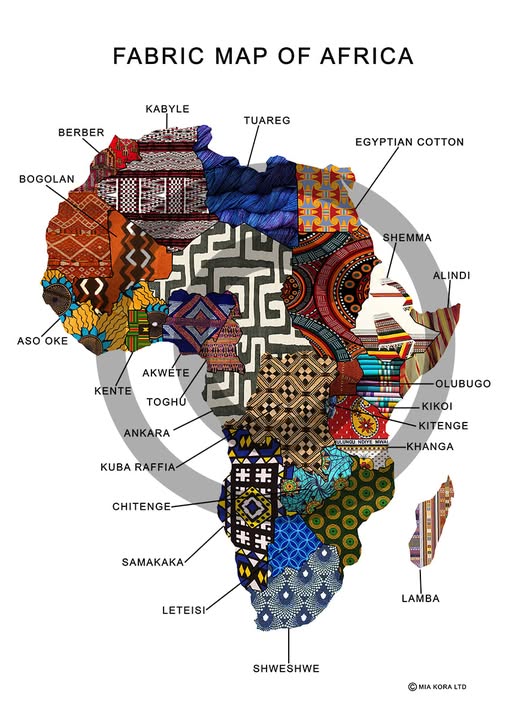
Africa is a continent of over 50 countries and thousands of ethnic groups — and its fabrics are just as gloriously diverse. Here’s what sets each one apart:
East & Central Africa
Kitenge / Chitenge / Pagne
Direct screen-printed 100% cotton.
Heavier weight, excellent structure for tailoring.
Dominant in Kenya, Uganda, Tanzania, DRC, Zambia, Malawi, Rwanda. In the DRC, known as pagne — practically the national uniform.
West Africa
Ankara / Dutch Wax Print
Defined by its wax-resist dyeing process — wax is applied before dyeing, creating that distinctive crackle texture on pattern edges.
Richer depth, more complex production.
What East Africans call kitenge, West Africans often call Ankara. Same love. Different accent.
Ghana — Ashanti Kingdom
Kente
Handwoven on traditional wooden looms in narrow strips (4 inches wide), then sewn together. Indigenous, ancient, deeply West African.
Requires years of apprenticeship. Every pattern has a name, a proverb, a story.
Authentic kente: $50+ per yard. Non-negotiable cultural prestige.
East Africa — Swahili Coast
Kanga / Leso
Lighter and thinner than kitenge.
Sold in rectangular pairs, designed to be draped and tied rather than tailored. Every kanga carries a Swahili proverb — a secret language of communication.
Originated in Zanzibar and Mombasa, 1870s. Distinctly coastal, Swahili, female-coded.
Kenya — Coastal Heritage
Kikoi
Woven cotton (not printed), characterized by striped or plaid patterns and fringe edges.
Originated among Swahili communities of the Kenyan and Tanzanian coast. Tactile and textural where kitenge is bold and printed.
Equally beautiful, completely different soul.
South Africa
Shweshwe
Printed cotton with geometric patterns. Deep-dyed, often in indigo, rust, or black. Strongly associated with Sotho and Xhosa communities.
A fabric of ceremony, mourning, and celebration in equal measure. South Africa’s equivalent of Kitenge’s cultural weight.
The secret is working with a good tailor who understands your vision. In Nairobi — from Gikomba to Westlands — skilled hands will take your 6 yards and turn it into something that makes people stop and ask: “where did you get that?”
Shop 6 Yards — 100% Cotton Kitenge ↗
20 Chats Who Are Making Kitenge the Main Character
The Magic Number
What 6 Yards of Kitenge Can Become
6 yards. One number. Infinite possibilities. When you buy kitenge, you purchase it in standard lengths — 3 yards (one piece) or 6 yards (two pieces). A single 6-yard length is the golden standard. It is enough to completely transform your wardrobe.
Here’s proof:
Save this. Screenshot it. Keep in your clouds like a special album.
Nnalolile Kitenge Inspo Wall
Nnalolile Yvi
Atoto Atori
Kenya / Uganda
A story about a beautiful woman in finance.
I ended up in Business School without ever planning for it.
No groundwork laid in high school, no grand strategy — just a sudden arrival in a world where my A-grade mean in Art & Design felt less like an achievement and more like a punchline.
I could practically sense the quiet amusement around me.
So I adapted.
Quickly.
The smartest move I could think of was learning directly from the best in the room. If I could win the class representative role at the official ballot — already agreed upon by the class — I’d have a legitimate reason to collect everyone’s assignments before submitting them.
Free access to the sharpest thinking in the cohort.
Bedtime reading, curated by merit.
The assignment I looked forward to most was always from one J. E. Mwelu. Her papers were precise, considered, and quietly brilliant. I’d hold off submitting the batch until I’d read every word of hers — then watch the lecturer’s expression when the work came back.
It took a while to connect the name to the face. J. E. turned out to be the girl who’d been smiling my way each time I glanced at what she was wearing.
I never quite conquered Finance. But the habit carried me further than I expected. And when I’d grown steady enough in Business Studies that the class rep role had lost its charm, one thing hadn’t — African print fashion.
Her tailor: Ellen Designs
Boss J. E
Yvonne Mwachi
Architecture. Project manager
Rheen
Travelpreneur | Enjoyment Officer | Biker: Partnerships, Consultation & Itinerary planning
Maureen Nkatha
Founder Kairetusapparel
Ikran Omar
Brand Ambassador
Kenya, Somalia
Shari Afrika
Royal priestess 👑
Luo Griot
Lizbeth Wanjiku
Commercial model, Brand influencer, for Fashion and LIfesytle.
Kenya
Leah Wekati
Youtube vlogger
Kenya/CA
Ayooluwa Oludele
Ankara bombers with tracksuits, mixed-print looks that break every Western fashion “rule.” Lagos cool, defined. Makes fashion editors nervous. In a good way.
Rachel Ray
Pilot
Anita Barbra
KE
Zozi Tunzi
African print set + Zulu-inspired statement jewelry and Miss Universe 2019, Actress, International TV Host & MC Wears African print with the regal confidence of someone who knows it belongs on global stages. Diplomacy, but make it fashion.
Zen
✨ Fashion | 🏋️♀️ Workout | 🌍 Adventure•Curating strength and style, wherever life leads.
Diana Ezenagu
Ankara corset + high-waist trouser, London-layered; Navigates Afrobeats culture and London street style with equal authority. Shows how kitenge translates to diaspora life without losing any of its original power.
The Architects
The Design Houses That Put African Print on the Global Stage
Kitenge, Ankara, and African print didn’t arrive at Paris Fashion Week or Harrods by accident. Visionary designers — many of them African-born or African-rooted — spent decades proving that African fabric belongs in the conversation with the best the world has to offer.
01 Lisa Folawiyo Studio
Nigeria · New York & Paris Fashion Week
The queen of elevated Ankara. Transformed African wax print by adding hand-beading, sequins, and embellishment — pieces requiring up to 240 hours of artisanal work.
Clients include Lupita Nyong’o, Beyoncé, and Solange Knowles. Didn’t just make Ankara fashionable — made it luxury.
02 Duro Olowu
Nigeria / UK · London Fashion Week
The master of the mixed print. In 2005, British and American Vogue both named his patchwork ‘Duro’ dress as Dress of the Year. Michelle Obama became one of his most high-profile fans.
Stocked at Harrods, Barneys New York, Biffi Milan.
03
Ellen Designs
Ellen Designs is what happens when passion refuses to stay quiet. Founder Hellen Tolbert started the business with just Ksh 5,000 — what remained after she walked away from formal employment to bet on herself.
Her mother was a tailor at Burma Market along Jogoo Road, and watching her turn raw fabric into something beautiful was where it all began. From cleaning toilets at Java to running a multimillion fashion house in Nairobi — the distance between those two points is the brand’s quiet testimony.

Today, Ellen Designs blends timeless elegance with a deep appreciation for African culture, using patterns, colour, texture, and Kenyan textile motifs to bridge the traditional and the contemporary.
Bespoke by design, each piece is crafted to reflect quality, craftsmanship, and style — with an established presence across Africa, Europe, and America, and a growing reach into Asia.
The kind of label you discover and then wonder how you dressed without it and the House is responsible for Boss J. E African prints
.
04 Katungulu Mwendwa
Kenya · International Showcases
One of Kenya’s most internationally recognized designers. Grew up in Nairobi watching her grandmother source materials from local artisans.
Returned from London fashion studies to build a brand using African fabrics — including kitenge — in innovative, modern silhouettes.
05 Deola Sagoe / House of Deola
Nigeria · African Haute Couture
A pioneer of African haute couture. Has dressed Oprah Winfrey and Will Smith. Uses African textiles in haute couture silhouettes that redefined what ‘formal’ and ‘luxury’ could mean when rooted in African fabric heritage.
How to Wash Kitenge Fabric Without Wrecking Your Drip
The Ritual
Your kitenge deserves love.
Treat it right and it will outlast trends, seasons, and relationships.
First Wash
Before wearing new kitenge, hand wash in cold water with a small amount of salt and white vinegar.
This sets the dye and prevents bleeding.
Do this BEFORE it touches your washing machine or your skin. Non-negotiable.
💧
Machine Wash
Cold or lukewarm only — never hot. Gentle/delicate cycle. Turn inside out.
Mild detergent, no bleach. Wash with similar colors.
Your kitenge and your whites are not friends.
🌀
Hand Wash (Gold Standard)
Cold water + gentle detergent. Gently agitate — don’t scrub or wring. Rinse thoroughly. Squeeze, never twist.
Hand washing extends the life of your print significantly.
🤲
Drying
Air dry in the shade — direct sunlight fades color over time. Hang or lay flat.
No tumble dry on high heat.
In humid climates, ensure good airflow to prevent mildew.
☁️
Ironing
Iron while slightly damp, inside out, on medium heat.
Use a pressing cloth on the right side to protect the print.
Steam ironing works beautifully for kitenge’s cotton weave.
♨️
Storage
Fold rather than hang heavy garments to prevent stretching.
Store in cool, dry, away from light.
Cedar blocks or lavender sachets keep insects away naturally.
📦
For Investors & Designers
Why Kitenge Is the Sourcing Opportunity You’re Not Talking About
The global African print market is not a niche — it is a growing, culturally charged, diaspora-backed, Gen Z-driven category with serious commercial momentum.
Whether you’re a fashion designer sourcing fabric, a brand looking to expand into African textiles, or an investor building a supply chain in East African textile: this is the conversation.
- $31B+ African fashion market value, growing year on year with accelerating diaspora demand.
- 100% Cotton. The kitenge sold at YVI Shop is pure cotton — no synthetics, no compromise.
- 6yds Standard order unit. Ideal for designers, tailors, and small batch collections.
- Kenya Sourced and shipped from Nairobi. Supporting East African fabric trade directly.
What We Offer at YVI Shop × Atoto & Atori
At Yvishop we carry 100% cotton kitenge in 6-yard rolls — the standard unit used by tailors, fashion designers, and small-run collections across East Africa and the diaspora.
Whether you’re a designer building a capsule collection, a buyer sourcing for a boutique, or an investor looking to understand the supply landscape — start here.
We look at fabric the way we look at culture: with precision, with respect, and with the understanding that what you choose to carry says something before you open your mouth.
Kitenge Fabric — Your Questions, Answered
Kitenge (kee-TEN-gay) is a brightly colored, 100% cotton printed fabric beloved across East Africa, Central Africa, and parts of Southern Africa. Known for bold geometric and floral patterns, vibrant color combinations, and a thicker weight that gives it excellent structure for tailoring garments.
Kitenge uses an industrialized version of the batik printing technique — designs are screen-printed directly onto cotton. The word comes from Swahili. Dominant in
- Kenya,
- Tanzania,
- Uganda,
- the DRC,
- Malawi,
- Zambia, and
- Rwanda.
Its lineage traces to Indonesian batik techniques that arrived on the East African coast through Indian Ocean trade, were absorbed into local culture, and became something entirely and beautifully African.
The key difference is production method and geography. Ankara (West Africa — Nigeria, Ghana) uses a wax-resist dyeing process: wax is applied before dyeing, creating a distinctive crackle texture on pattern edges — a richer, more tactile result.
Kitenge (East and Central Africa) uses direct screen printing, applying dye straight to cotton. The visual result is similar to the untrained eye, but texture and depth differ.
Many fabrics sold as ‘kitenge’ in Nairobi and ‘Ankara’ in Lagos come from the same factories in China or West Africa. The name, the cultural framing, and the geography differ — the love is the same.
6 yards is the golden standard. For women: a full wrap dress with headwrap, a blazer and wide-leg trouser suit, a peplum blouse and skirt set, a corset gown with train, or two separate looks (mini skirt + midi wrap dress).
For men: a senator set (shirt + trousers), a full agbada for ceremonies, a bomber jacket with matching shorts, or a structured blazer with pocket square. For the home: throw pillows, a table runner, framed wall art, or a baby wrap carrier. One purchase. One visit to your tailor. Infinite wardrobe.
First wash: Before wearing new kitenge, hand wash in cold water with salt and white vinegar to set the dye and prevent bleeding. Do this before the fabric touches your washing machine.
Ongoing care: Machine wash cold, gentle cycle, inside out, mild detergent, no bleach. Never wash with whites. Hand washing in cold water is the gold standard — gently agitate, never wring. Air dry in shade (sunlight fades color). Iron slightly damp, inside out, medium heat. A steam iron works beautifully on cotton kitenge.
You can buy 100% cotton kitenge in 6-yard rolls at YVI Shop — Atoto & Atori — sourced in Nairobi, available online, ships across Kenya and internationally.
In person in Nairobi: Gikomba Market and Westlands fabric shops. In Mombasa: Mwembe Tayari market. Diaspora buyers can order directly through YVI Shop.
Same fabric, different accent depending on where you are: Chitenge (Zambia, Malawi, Zimbabwe), Pagne (DRC, Cameroon, Francophone Central and West Africa), Ankara (Nigeria, Ghana), Dutch Wax Print / Holland Wax (referencing the original European production history), and African Wax Print (the global fashion media catch-all).
All are cousins — varying by region, production nuance, and cultural context, but all tracing lineage to Indonesian batik adopted and elevated by African communities.
Yes — resoundingly. Men across East and Central Africa have worn kitenge for generations. In the DRC, full kitenge suits are standard formal wear. In Kenya, kitenge shirts and jackets are worn to weddings, funerals, and board rooms. In Nigeria, Ankara agbada and senator sets are the dress code at owambe parties that live in your camera roll forever.
For Gen Z men in the diaspora: a kitenge blazer over joggers in London, a co-ord at an Afrobeats concert in Toronto, a tailored blazer at a New York networking event. Men wearing African print is not a trend — it’s a tradition reclaiming its global stage.
Get Your 6 Yards. Wear Your Map.
100% cotton kitenge, sourced in Kenya, available now at YviShop For designers, tailors, fashion-forward individuals, and anyone who believes what you wear speaks before you do.
Leave a Reply