
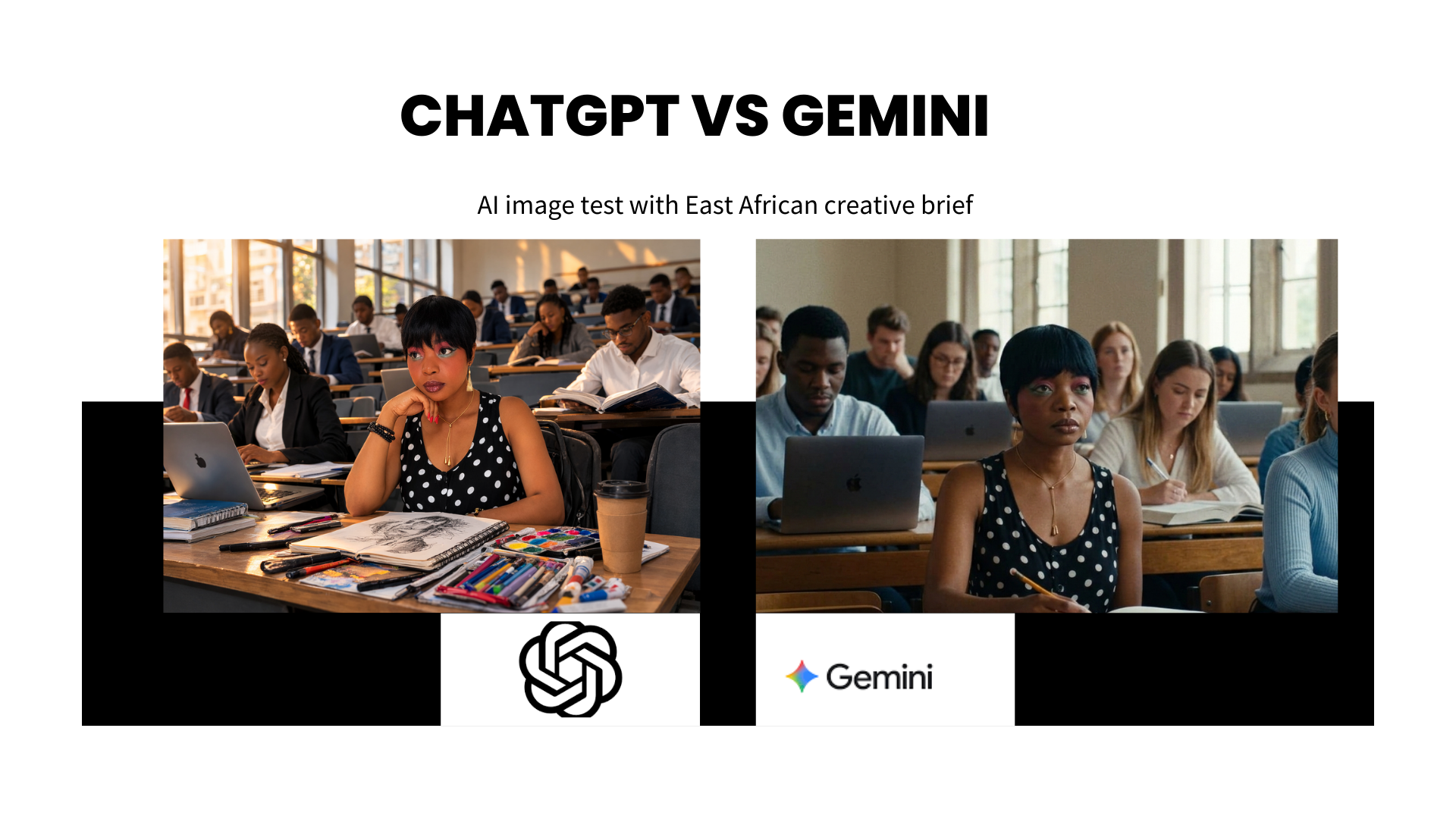

We ran the same creative brief through both. The results were not what we expected. Created by Claude, as text to image prompt for a blog featured image for a story of a beautiful woman in Finance
The prompt wasn’t complicated
— an East African art student who accidentally ends up in Business School. Sketchbook on the desk. Watercolours open. Business textbooks stacked beside her. She doesn’t quite fit in the room, and she knows it.
Simple enough. Except we ran it through both ChatGPT (DALL-E 3) and Google Gemini at the same time. And the gap between the two outputs told us something worth writing about.
The Brief That Started It
The test came out of a real piece of writing — a persona story of Ms. Victoria Musebe who ended up in Business School without planning for it, carrying an A-grade mean in Art & Design into a room full of Economics textbooks — and quietly figuring out how to survive.
The character needed to feel true. Not generic. Not stock photo. The image had to carry the weight of that specific tension: creative identity colliding with academic expectation, set firmly in an East African context.
That’s the brief we gave both tools. Same words. Same intention. Two very different outcomes.
What ChatGPT Did
ChatGPT went editorial. Immediately.
Golden-hour light flooding a wooden lecture hall. A young woman — bold makeup, black polka-dot dress, gold drop earrings — sitting behind a desk stacked with textbooks literally labelled MARKETING, FINANCE, BUSINESS STRATEGY, ECONOMICS. Watercolours open. Fashion sketches visible in the notebook. Everything intentional. Everything lit.
It read the room and dressed it for a magazine cover.
The detail work was precise — the stacked books weren’t an accident, they were a statement. The art supplies weren’t background noise, they were a counterpoint. ChatGPT clearly understood the conflict in the story and staged it visually.
What ChatGPT asked itself: How should this look?
The answer: striking, warm, highly composed — the kind of image that stops a scroll.

What Gemini Did
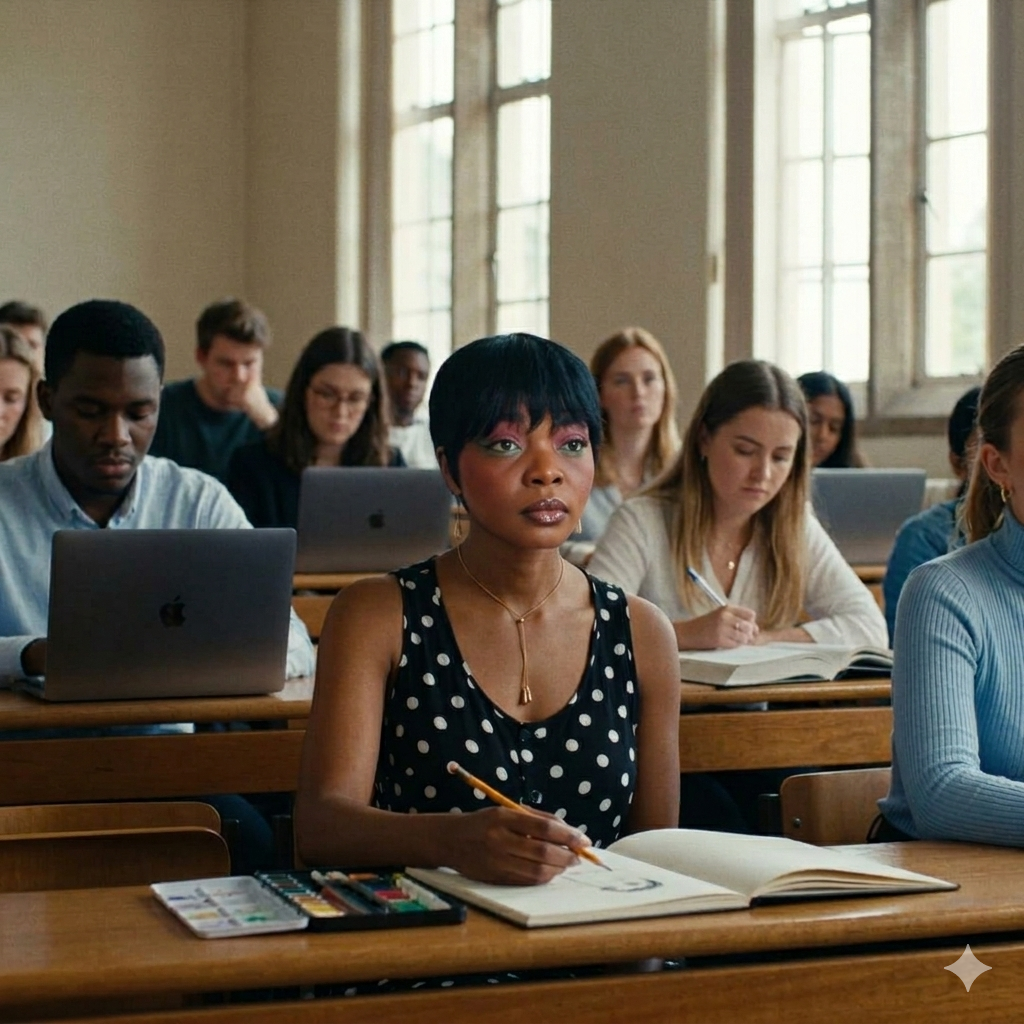
Gemini went cinematic.
Cooler tones. A wider shot. The same character — same short fringe, same quiet confidence — but now she’s in a broader classroom, surrounded by students who blur into the background. She holds a pencil above a sketchbook. A watercolour palette sits to the side. The light comes through tall windows, cool and indirect.
It felt less like a photoshoot and more like a still from a film. The tension was felt rather than shown. No labels on the books. No golden light cueing you how to feel. Just a woman, slightly apart from the room around her, looking forward.
What Gemini asked itself: How should this feel?
The answer: restrained, atmospheric, quietly unsettling in the best way.
The Honest Comparison
Neither tool got it wrong. They answered different questions.
| Features | ChatGPT (DALL-E 3) | Google Gemini |
|---|---|---|
| Tone | Bold, editorial, warm | Cinematic, cool, restrained |
| Lighting | Golden hour, dramatic | Natural, diffused |
| Detail | Deliberate, symbolic | Suggestive, ambient |
| Best for | Social media, blog headers, campaigns | Storytelling, mood boards, long-form |
| African context | Strong — warm tones, East African features | Moderate — setting felt less specific |
| Scroll-stopping power | Very high | Medium-high |
What This Means for Kenyan Creatives
If you’re a content creator, brand, or business in Kenya using AI image tools, here is the practical read;
Use ChatGPT when
the image needs to land in under two seconds. Product launches. Campaign visuals.
Social media posts where the viewer is scrolling fast and you need impact now.
ChatGPT stages the scene for maximum effect and doesn’t leave much to interpretation — which is exactly what you want when attention is the product.
Use Gemini when
the image is part of a longer story. Editorial features.
Brand narratives. Look-books. Anything where the emotional atmosphere matters more than the immediate hook.
Gemini gives you mood, and mood is what makes people stay.
The honest limitation for both:
Neither tool defaults to an East African visual identity without prompting.
Left alone, ChatGPT trends toward a generalized “African editorial” aesthetic.
Gemini trends toward a cooler, vaguely European classroom feel — notice the student body in its outputs leaned mixed rather than East African.
The more specific your prompt about place, skin tone, architecture, fabric — the better both perform.
This is not a small issue. If you’re telling Kenyan stories with AI images, you have to do extra prompt work to pull the visual output toward your actual reality. That labour gap is real, and it falls on us as African creators to close it.
The Prompt That Made the Difference
For what it’s worth, here’s what worked:
“East African woman, short black fringe hairstyle, bold eye makeup, seated at a wooden university lecture desk. Sketchbook and watercolour palette in front of her. Stack of business textbooks beside her. Other students studying in the background. Warm golden light. Fashion editorial style. Nairobi university setting.”
Being explicit about Nairobi, East African, wooden lecture desk moved both tools significantly closer to the right context.
Vague prompts get vague outputs.
Specific geography gets specific images.
Our Verdict
ChatGPT wins on impact.
If the image has one job — stop the scroll — ChatGPT does it better, more consistently, and with less iteration.
Gemini wins on atmosphere.
If the image needs to carry emotional weight across a longer piece of content, Gemini’s restraint works in its favour.
For Kenyan storytelling specifically:
both tools need explicit geographic and cultural prompting to get close to accurate. Neither has East Africa in its visual default. That’s the work we have to do — and frankly, it’s also the opportunity. The creator who masters African-specific AI prompting right now has a competitive edge that won’t last long once everyone figures it out.
The tools are good.
The prompts are the skill.

If you’re thinking about AI tools beyond image generation, our earlier breakdown of DeepSeek vs ChatGPT vs Claude for Kenyan users covers the privacy, cost, and career angles worth knowing before you commit to any platform.
And if you’re curious about the story that started this test — the Business School girl with the sketchbook — that’s Boss J-E. Read it first. The images make more sense after.
What are you using for AI image generation for your business?
If your brand needs African-specific AI content strategy, this is the work we do.
Nnalolile For Business
If your brand needs African-specific AI content strategy, this is the work we do.
Leave a Reply