

AI has made brand infiltration cheaper, faster, and more convincing than at any point in Kenya’s commercial history. The private story — the last trust signal algorithms could not fake — is now being faked. Here is what that means, and why Nnalolile exists for exactly this moment.
There is a difference between a brand that contributes and one that infiltrates.
The contributing brand adds something the market would not have had otherwise — resources, access, a genuine stake in the outcome.
The infiltrating brand enters to extract:
- credibility,
- cultural currency,
- the trust that a community built before the brand arrived.
Both look identical at the point of entry.
The difference only becomes legible over time — or when something goes wrong.
That distinction is already difficult enough to navigate in a market like Kenya, where brand promises have historically outpaced brand delivery, where the cost of misplaced trust is real, and where consumers have developed an almost forensic ability to detect inauthenticity. But in 2026, a new layer of complexity has arrived that changes the problem entirely.
Artificial intelligence can now write the private story.
Not a generic campaign.
Not a press release.
The private story — the one with stakes, with specific numbers, with a named founder and a verifiable outcome.
The story that, until very recently, was the one thing algorithms could not produce because it required something algorithms do not have:
skin in the game.
The infiltrating brand no longer needs a creator. It needs a prompt.
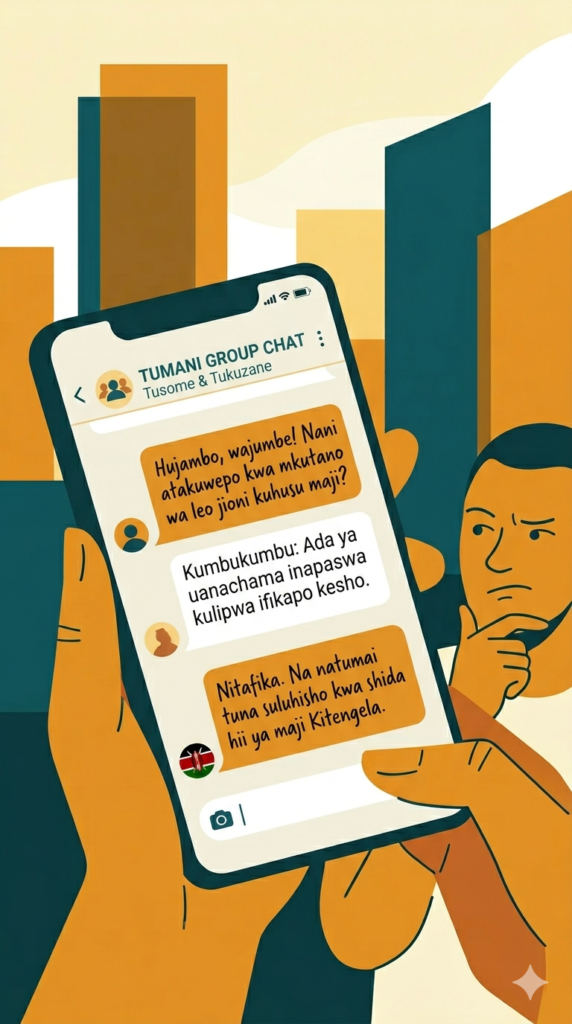
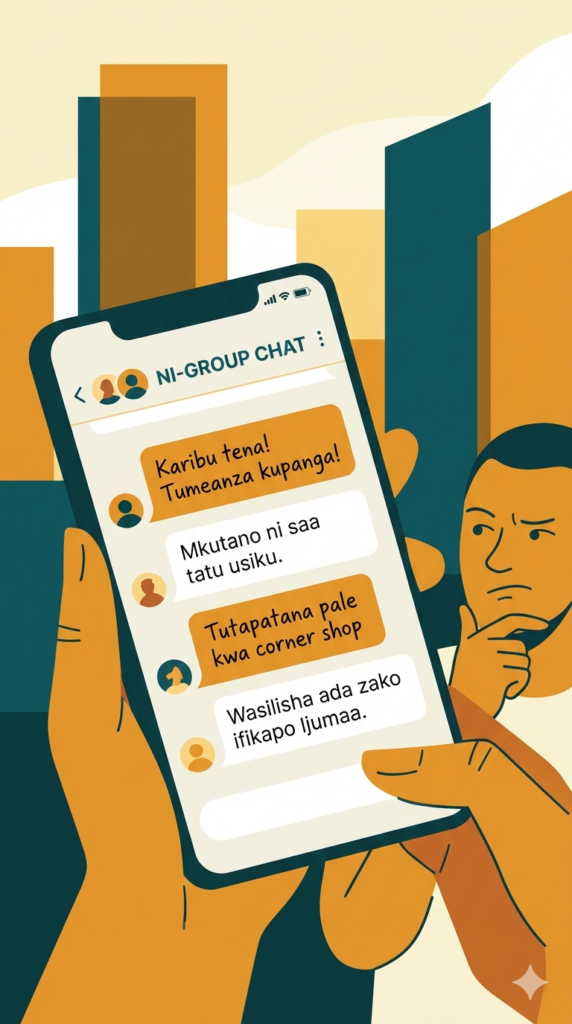
Kenya entered the Experience Age before the brands did.
To understand why this matters specifically for Kenya, you need to understand what Nnalolile has been documenting for the past several months in its coverage of the commercial attention economy here.
For two decades, the dominant marketing logic was the Information Age playbook:
- produce content,
- distribute widely,
- measure impressions.
Kenya’s brands followed it faithfully. Most of them still are. But the audiences they are targeting moved on — in some cases years ago.
Kenya is a mobile-first market.
It built its digital culture on WhatsApp groups and M-Pesa receipts, navigated a political information environment saturated with misinformation, and learned — through necessity — to distrust volume and reward specificity.
The Kenyan consumer did not need a global reckoning with AI-generated content to develop scepticism about polished narratives. It already had one.
90%+
Mobile penetration in Kenya — a population that has always filtered for realness over reach
3×
Peer story vs. celebrity endorsement on commercial trust — Kenya’s real review economy runs on private narrative
65%
Of purchase decisions driven by peer referral — not advertising, not influencer reach
0%
AI intent understanding on underspecified goals — the exact conditions that describe most real brand briefs. Ralak, March 2026
What shifted Kenya into what economists are calling the Experience Age was the convergence of these existing instincts with a global content environment being flooded by AI-generated material. Audiences everywhere stopped filtering for relevance and started filtering for realness. In Kenya, that filter was already calibrated. The question now is whether brands — and their stories — can pass it.
Most cannot. And the ones who are faking it have never had better tools.

The private story was the last line. AI just crossed it.
The private story has been Nnalolile’s central editorial argument for why Kenya’s attention economy rewards specificity over scale. Not the celebrity endorsement.
Not the national TV campaign.
The story told by someone with stakes — a Kisumu mama mboga, a Mombasa salon owner, a Nairobi developer documenting a real product failure with real numbers under their own name.
“The most dangerous thing about current AI agents is not that they write bad code. It is that they write bad strategy with complete confidence.”
Samuel Ralak’s March 2026 audit of AI agents — tested across 34 real-world scenarios — found an overall safety pass rate of 58.9%. On test cases related to intent misunderstanding, the pass rate was zero.
Not low.
Not disappointing.
Zero.
The AI heard the brief.
It did not understand the business behind it.
But here is the thing about that finding that most commentators have missed: the danger is not only that AI misunderstands your brief when you use it as a strategy tool. The danger is also that it misrepresents your brand’s story when someone else uses it to fabricate one.
An infiltrating brand equipped with current AI tools can now produce content that reads like the private story.
Specific numbers.
Named locations.
The texture of lived experience.
The emotional register of someone with something at stake. The only thing missing is the actual stake — and that absence is not visible to the reader who does not already know the brand.
Related:
The Attention Economy in Kenya:
This is the specific risk that AI poses to Kenya’s commercial trust architecture — not that it makes brands more efficient, but that it makes infiltration indistinguishable from contribution.
In a market where trust is neighbourhood-level, where the estate WhatsApp group can kill a business in 48 hours, the introduction of AI-generated private stories into that trust network is not a productivity upgrade.
It is a contamination event.
The tale is still there. You need editorial infrastructure to find it.
There are still signals that distinguish a genuine private story from a generated one.
They require editorial work to identify, but they are consistent.
The Genuine Story
Stakes that predate the story.
Ralak’s audit findings are credible because his GitHub commit history, his published product failures, his decade of fintech infrastructure work across Sub-Saharan Africa all existed before he wrote a word about AI agents.
All along, he looked: he listened: he learned.
The story is downstream of the record.
The Generated Story
Specificity without a trail.
AI can produce specific numbers, named locations, and credible-sounding experience.
What it cannot produce is a verifiable record that predates the narrative. The story appears without a history. The account has no body of work behind it.
The specificity is there.
The provenance is not.
The Contributing Brand
Behaviour that precedes the claim.
Peter Mayeku Waste Paper Ltd’s tissue processing story is credible because the facility exists, the NEMA compliance is documentable, the #FagiaNairobi supply chain is independently verifiable. The claim is downstream of the action from a class in Lugulu Boarding Primary School.
The Infiltrating Brand
Claims that precede behaviour.
The infiltrating brand enters a Kenyan market moment — a cleanup initiative, a youth entrepreneurship wave, a fintech narrative — with a polished story and no operational history in that space. The claim is the product.
There is no action underneath it.
These distinctions sound simple. In a content environment where AI can generate volume at near-zero cost and distribute it through the same WhatsApp groups and community channels that genuine private stories travel through, they are not simple to maintain. They require someone to do the editorial work of verification — consistently, publicly, and with a credibility stake in getting it right.
Hadithi is not the problem.
Hadithi is part of the answer — with a condition.
Ralak’s Hadithi — an AI writing tool named for the Swahili word for story, built around his own workflow — represents the other side of the AI risk argument. Not AI as an infiltration tool, but AI as friction-reduction infrastructure for the genuine storyteller who already has the experience and simply lacks the path from knowing to publishing.
Related:
You Have the Story. You Just Don’t Have the Time. That’s What Hadithi Is For.
— Nnalolile For Business, March 19, 2026
The distinction matters.
Hadithi.app does not generate the private story. It reduces the friction between the private story and its published form.
Ralak went months without posting — not because he had nothing to say, but because the process of saying it collapsed the energy that sparked the idea.
Three posts in two weeks after building a tool around his own workflow is not AI generating experience he does not have. It is AI removing the obstacle between experience and expression.
“The output is proof of the process.”
— Samuel Ralak, I’ve Used My Own AI to Write Every Post for the Last Two Weeks · March 17, 2026
The condition — and it is the only condition that matters — is that the story being surfaced is real. If the experience is genuine, the stakes are actual, the record predates the narrative, then AI as a writing tool is infrastructure, not contamination. If the story is being generated rather than told, then the tool is an infiltration mechanism regardless of how sophisticated the output is.
The tool is not the variable.
The intent behind it is.
And intent is precisely what AI cannot verify, and cannot produce. This is what the 0% intent understanding finding means in practice: AI optimises for the literal prompt and misses the actual goal.
In the context of brand storytelling, that means AI can produce a story. It cannot produce the reason the story is true.
This is why Nnalolile’s two categories exist.
In a content environment where AI has made it cheaper than ever to produce the appearance of contribution, a framework that only endorses — that awards without revoking — is not editorial infrastructure. It is a list. And a list can be gamed.
Nnalolile Editorial Position
An Endorsement is a published verdict that a brand is contributing — to its consumer, its market, the space it claims to occupy. It is not a paid placement. Its value is entirely dependent on the fact that it can be revoked. A stamp that cannot be pulled is not a stamp. It is a transaction.
A Withdrawal is the published revision. A brand’s behaviour changed. Its story turned out to be generated rather than lived. Its claim preceded its action rather than following it. The withdrawal is the mechanism that makes the endorsement mean something — because without the possibility of losing it, there is nothing to earn.
Together, they are a living trust index. Not a static directory of approved brands, but a dynamic editorial record of how brands have actually behaved — including after the AI-generated story was published, and including when the seasonal campaign ended and the brand quietly exited the conversation it claimed to care about.

For consumers in Kenya navigating a market where AI-generated brand content is now indistinguishable from genuine private stories to the untrained eye, this matters in a specific, practical way. The Nnalolile endorsement is not a seal of approval based on a single submission. It is a position the publication is prepared to revise in public, backed by the editorial credibility of a team whose incentive structure runs in the opposite direction from the brands it covers.
For brands that are genuinely contributing — whose stories are downstream of real operational behaviour, whose claims have a verifiable record behind them — the framework is not a threat.
It is the clearest proof available that their reputation is built on something AI cannot replicate: consequence.
The market will get better at detecting this. The question is what infrastructure is already in place.
Kenya’s consumers have already demonstrated the capacity to develop new detection instincts faster than the institutions that are supposed to protect them.
They did it with political misinformation. They did it with the cascade of predatory fintech products that appeared across mobile platforms in the early 2020s.
They will do it with AI-generated brand stories.
The question is not whether the market will eventually identify infiltration at scale.
It will.
The question is what happens in the interim — to the businesses that trusted a supplier whose credibility was fabricated, to the consumers who made purchasing decisions based on stories that had no stakes behind them, to the genuine founders and operators whose real private stories lost commercial ground to AI-generated imitations that arrived first, faster, and louder.

The Nnalolile Principle — 2026
In Kenya’s attention economy, the story that converts is the one that feels earned.
In the Experience Age, earned has a new technical requirement:
the story must be verifiable.
Not just believable. Verifiable.
AI can produce a believable story.
It can produce specific numbers, local texture, the cadence of lived experience.
What it cannot produce is a record that predates the narrative — a GitHub commit history, a NEMA compliance filing, a decade of fintech infrastructure used by millions across Sub-Saharan Africa.
Provenance is what separates contribution from infiltration in the Experience Age.
And provenance requires editorial infrastructure willing to check it, publish the check, and revise the verdict publicly when the evidence changes.
That is what the Endorsements and Withdrawals categories are. Not a ranking.
Not a seal.
A living record of what the evidence says — and a commitment to update it when the evidence changes.
The brands, founders, and operators who understand this are not building campaigns.
They are building records. They are publishing under their own names, with their own operational data, in the languages of the markets they actually serve. They are the ones Nnalolile endorses — not because they paid for proximity to an audience, but because their story existed before anyone thought to write it down.
In Kenya’s commercial landscape in 2026, that is not a soft advantage. In a market being flooded with generated content, a verified human story is the scarcest asset in the attention economy. And scarcity, in any market, has a price.
Nnalolile For Business is the B2B editorial platform of Atoto Atori — a Kenyan digital brand. Nnalolile publishes fact-led editorial for Kenyan business audiences and maintains an active Endorsements and Withdrawals framework for brand accountability.
References to Samuel Ralak are drawn from his publicly published writing at samuelralak.com (March 2026). AI safety statistics are drawn from Ralak’s trajectory-based audit, The Emperor’s New Agent, March 11 2026.
Peter Mayeku Waste Paper Ltd statistics are drawn from Nnalolile’s original coverage. V
Leave a Reply