The Oldest Therapy: What Cats and Traditional Medicine Knew About Healing | Nnalolile For Business
YVI Sensual Health & Wellness · Traditional Medicine
The Oldest Therapy Had Four Legs.
On spine injuries, vibration machines, anxiety attacks, and what a purring cat taught me about a form of medicine that predates everything we call modern.
Nnalolile For BusinessEditorial · Wellnessatotoatori.co.ke/nnalolile
Nnalolile For Business · The Oldest Therapy Had Four Legs · Featured Image
A Personal Account
A few years ago, I was skating. The fall happened the way these things always do — fast, then slow, then suddenly very serious. I hit the ground at an angle that damaged my spine badly enough that I could not walk.
What followed were a few days at Langata Hospital, including physiotherapy and a treatment I still think about: a device placed against my back that vibrated at specific frequencies, designed to stimulate cellular repair. The machine worked. Slowly, then more noticeably, then enough that I walked out of that clinic on my own feet. It was extraordinarily expensive. It was also extraordinary.
Years later, my body had healed — but something else had shifted. I developed anxiety and depression, with episodes that swung between a kind of acute manic joy and deep, consuming sadness. The medical term isn’t important here. The experience was: you lose yourself in your own nervous system, and getting back feels impossible.
So I adopted a cat.
I did not know, then, what I know now. I just needed something alive in the apartment. What happened next is what sent me down a research rabbit hole that I am still climbing out of.
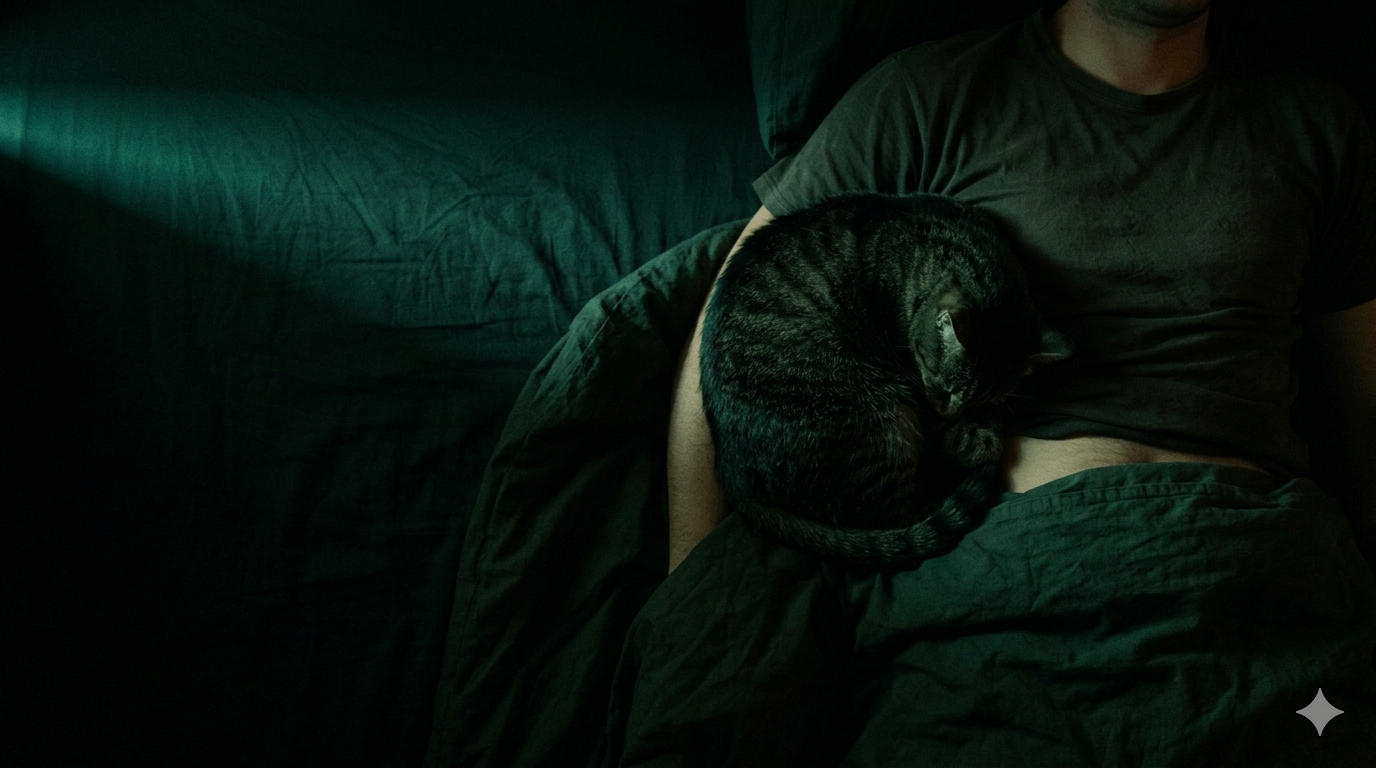
The body’s oldest signal. Warmth. Weight. Vibration. The parasympathetic nervous system reads all three as: safe.
The Cat That Knew
Whenever an anxiety episode began — and they announce themselves before they arrive, a particular tension that rises like water — my cat would notice before I did. She would cross the room, climb onto my chest or stomach, and begin to purr. We would lie there together, sometimes for an hour, sometimes for the better part of a night, until the episode receded and we both fell asleep.
I want to be precise about what happened physiologically: she sat on me and vibrated until I could breathe again. And then one day, rereading my physiotherapy notes from the spine injury years, I saw the frequency range on the vibration therapy device. I went very still.
25– 140
Hz — Cat Purring Frequency Range
The frequency range at which domestic cats purr overlaps almost exactly with the frequencies used in physiotherapy for bone density stimulation, tissue healing, and pain relief. The machine that helped rebuild my spine operated at frequencies a living animal produces naturally, by instinct, when it wants to comfort something it loves.
I had been in therapy twice — once biological, once emotional — by the same mechanism. One cost a significant amount of money and required a clinical setting. The other required a bowl of food and a warm space on the bed.
The machine that rebuilt the spine. The cat that rebuilt the mind. The frequency was the same both times.
What Traditional Medicine Always Knew
Here is the uncomfortable truth about much of what we call “alternative” or “traditional” medicine: the mechanisms often existed before the vocabulary to describe them. The purring cat is not folk wisdom that the science eventually debunked. The science eventually caught up with something that ancient civilisations had observed, encoded, and institutionalised long before anyone had a frequency counter.
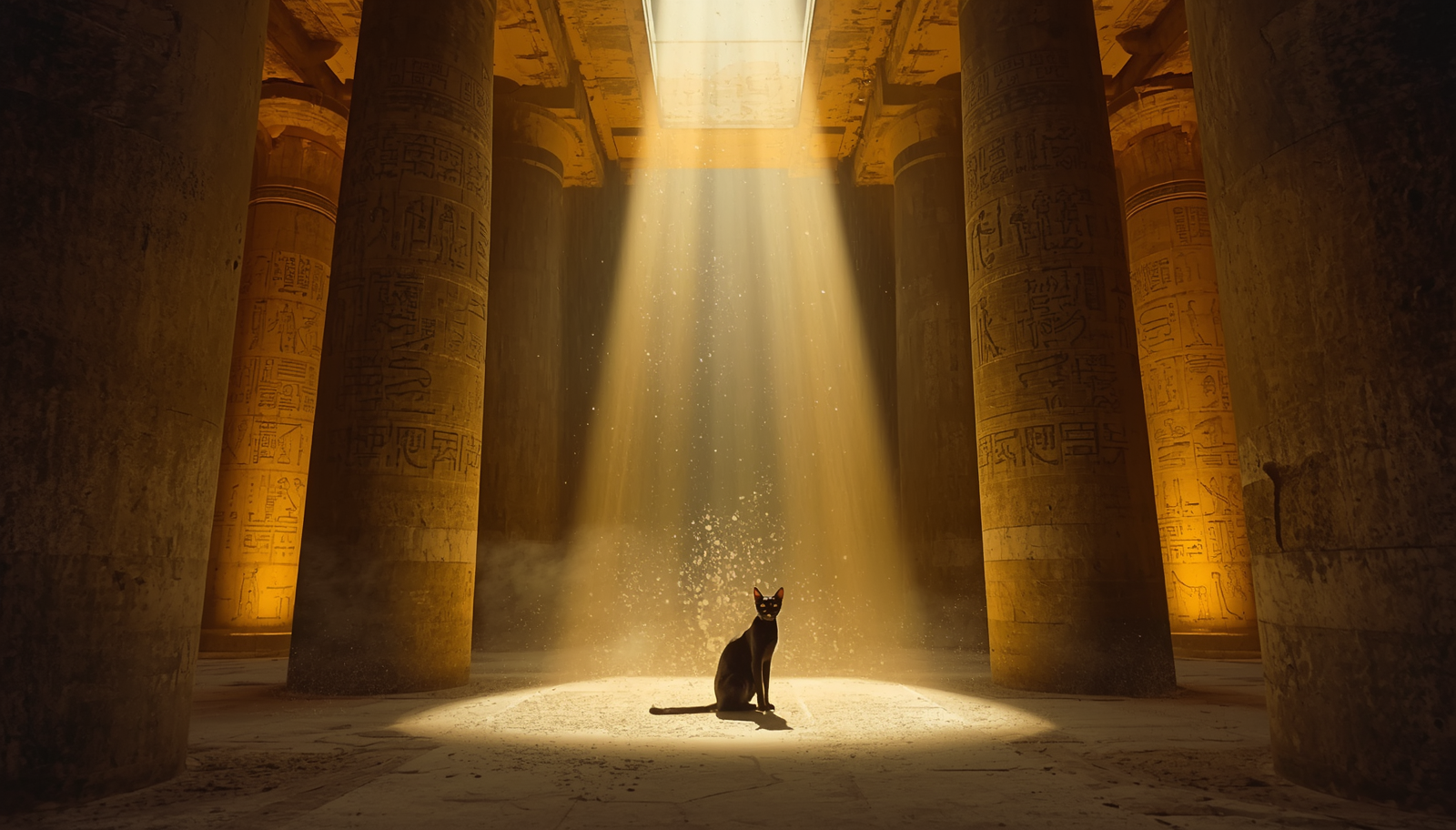
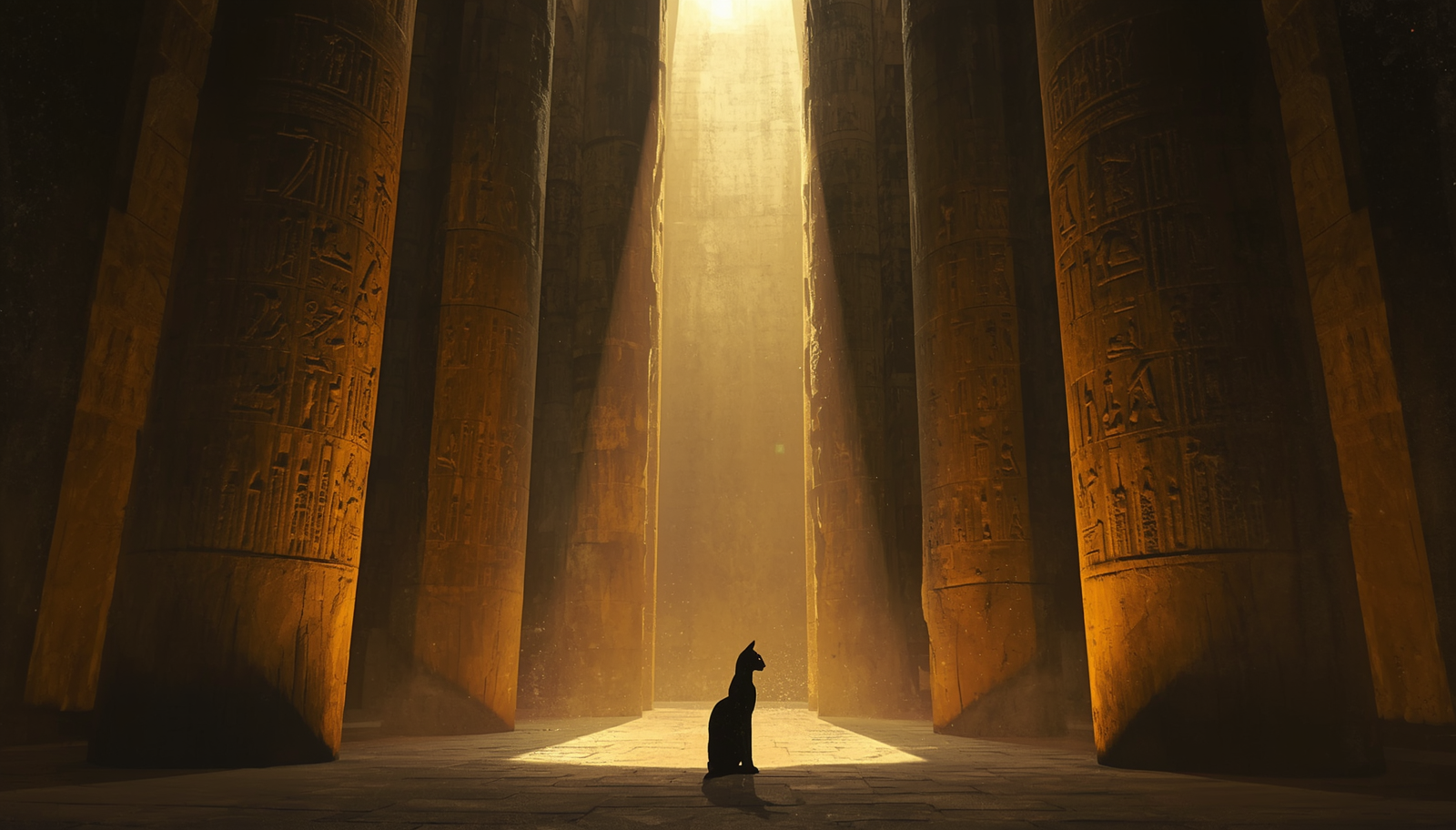
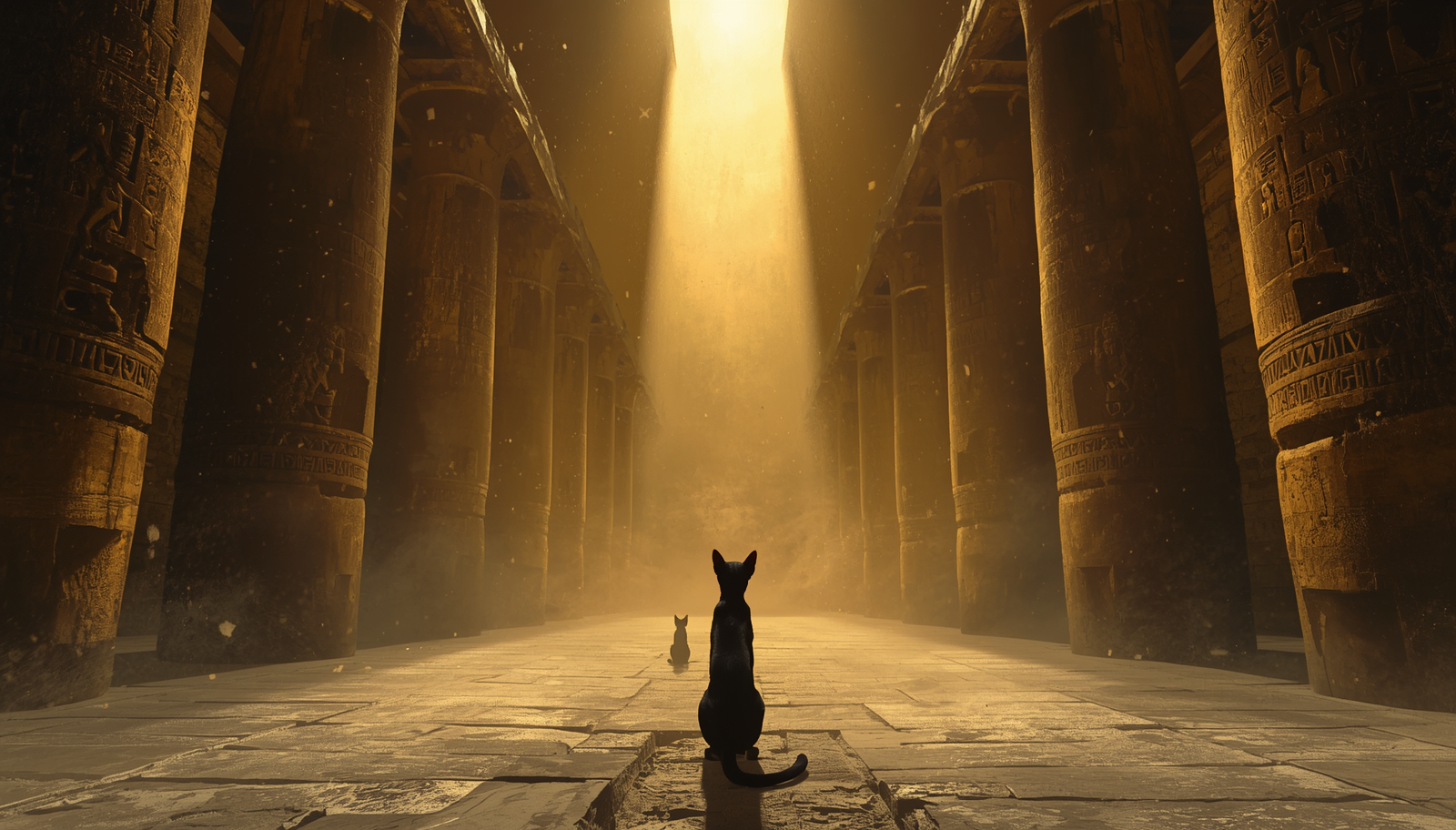
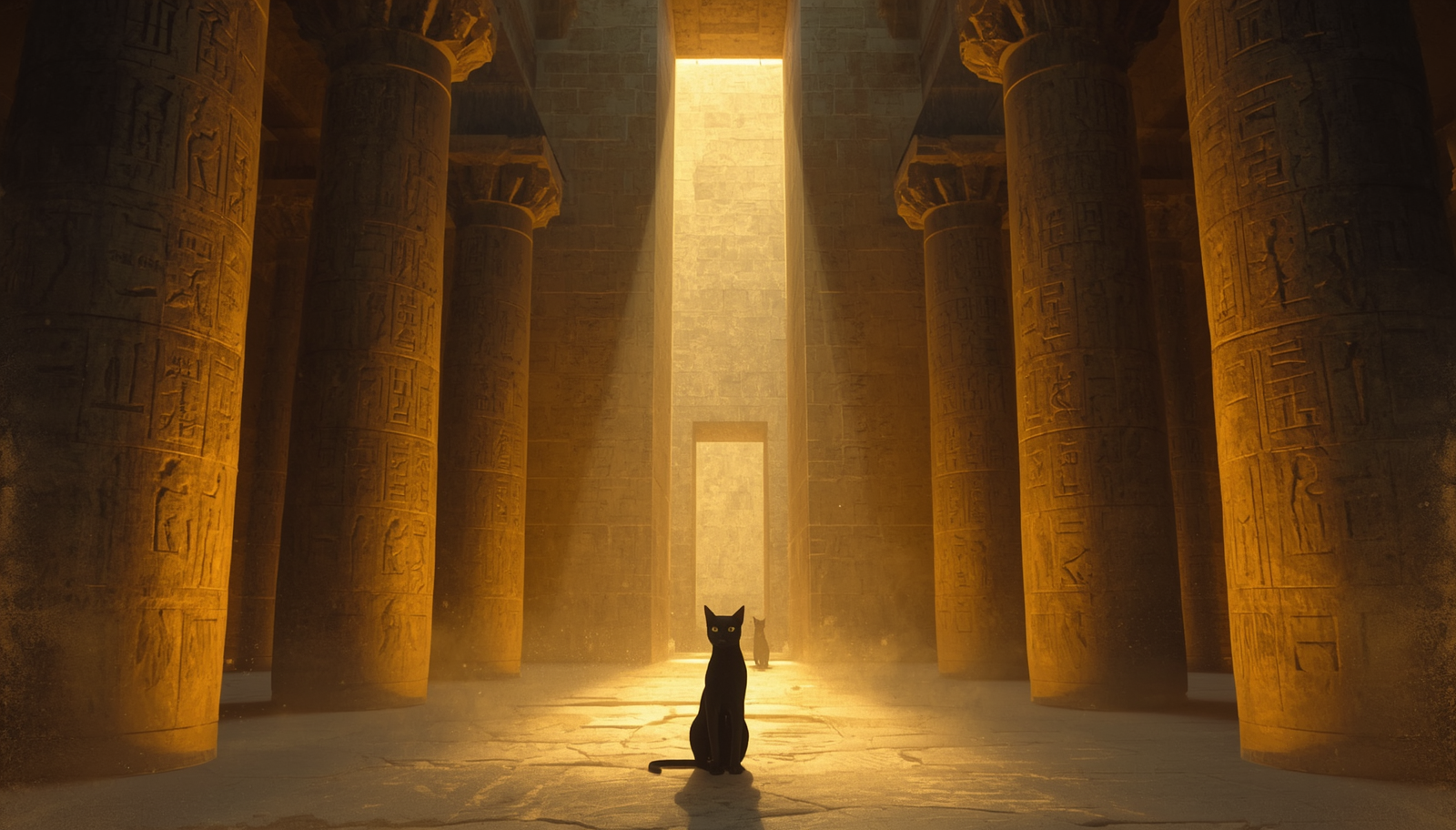
Ancient Egypt, ~3000 BCE. The goddess Bastet, the healing temple, the cats who moved between the living and the divine. The observation was the science — they simply hadn’t named the frequency yet.
Ancient Egypt · ~3000 BCE
Bastet and the Healing Temple
The goddess Bastet — depicted as a cat — presided over fertility, protection, and the home. Cats were kept in temples not only as sacred beings but as active participants in healing rituals. Ancient Egyptian physicians noted that the presence of cats measurably calmed patients before procedures.
Ancient Greece · Asclepion Sanctuaries
Animals in the Healing Sanctuary
Greek healing sanctuaries — the Asclepia — kept animals including cats as part of the therapeutic environment. Patients seeking cures for ailments slept within the sanctuary in a practice called incubation, in direct contact with these animals, to receive healing through dreams and presence.
Medieval Europe
The Healer’s Companion
Despite the infamous persecution of cats in certain periods of European history, monastic healers and apothecaries maintained cats in their spaces, recognising their effect on patient stress levels. The calming effect was documented anecdotally across centuries of medical writing.
East African Traditions
Animal Presence in Healing Practice
Across many East African healing traditions, the presence of particular animals during periods of illness or emotional crisis is understood as part of the restoration of balance — not metaphorically, but literally. The animal brings something. Traditional healers did not require a mechanism to know it worked.
What every one of these traditions understood, without the language of hertz or parasympathetic nervous systems, is that proximity to a purring cat changes the state of the body. This is not mysticism. This is observation, accumulated across thousands of years, that modern physiology has now begun to formally quantify.
The Science of the Purr
The cat’s purr is not a passive behaviour. It is an active, metabolically produced vibration generated by the rapid movement of the laryngeal muscles — the same muscles that control the glottis, which opens and closes as the cat breathes in and out. The result is a continuous sound and vibration that the animal can sustain even under stress. Cats purr when content, but also when injured, when giving birth, and when dying. The purr, researchers now believe, is self-regulatory — a mechanism the cat uses to soothe its own nervous system as much as yours.
Therapeutic Frequency Comparison
Cat purr (low)
25 Hz
Bone density stimulation
25–50 Hz
Cat purr (upper range)
~140 Hz
Clinical vibration therapy
25–200 Hz
Tissue / tendon repair range
100–200 Hz
Research Finding
What Low-Frequency Vibration Does to the Body
Studies in vibroacoustic therapy — the clinical use of low-frequency sound vibration applied to the body — show measurable reductions in pain perception, muscle tension, and anxiety scores among participants. The mechanism involves activation of mechanoreceptors in the skin and deep tissue, which signal the parasympathetic nervous system: the branch responsible for rest, digestion, and recovery.
In plain language: low-frequency vibration tells the body it is safe. The body listens. Heart rate drops. Cortisol — the primary stress hormone — decreases. The parasympathetic state, sometimes called “rest and digest,” becomes accessible again. This is exactly what happened on my chest during my anxiety episodes. My cat was administering vibroacoustic therapy with no formal training whatsoever.
What This Means for Mental Health
The anxiety and depression I experienced sit in a category that modern psychiatry sometimes struggles with — the kind of mental distress that doesn’t resolve neatly with medication or talk therapy alone, that lives in the body as much as in the mind. Somatic approaches — treatments that engage the physical body — have gained significant clinical ground in recent years precisely because they reach states that language cannot.
Vibration is one of those somatic tools. But so is warmth, weight, heartbeat, and the particular texture of a living creature that breathes and shifts and chooses to be present with you. A cat sitting on a person in distress delivers all of these simultaneously. The warmth of the body raises skin temperature and promotes vasodilation. The weight — a phenomenon now formalised in weighted blanket therapy — engages what is called deep pressure stimulation, which reduces sympathetic nervous system arousal. The heartbeat and the purr together produce a bioacoustic environment that the human nervous system reads as: safety. Not danger. Not alone. Safe.
The YVI Sensual Health & Wellness Centre
This is the philosophy the Centre is being built on.
The themes this article explores — vibroacoustic healing, somatic nervous system regulation, the body’s ancient memory of what safety feels like — are not incidental to what the proposed YVI Sensual Health & Wellness Centre is designing. They are foundational to it.
The Centre is built on a simple premise: the word “sensual” has been inappropriately narrowed. At its root, sensual means of the senses — touch, sound, temperature, vibration, breath, presence. These are the instruments of the oldest healing traditions on earth. The YVI Centre proposes to take them seriously, structurally, as a Kenyan institution.
〰️
Vibroacoustic & Sound Therapy
🤲
Touch & Somatic Bodywork
🌿
Traditional & Plant Medicine
🧠
Mental & Emotional Wellness
🔥
Thermal & Sensory Contrast
🫁
Breathwork & Nervous System Reset
The cat on my chest was not magic. It was a frequency, a weight, a warmth, a presence — and all four of these have clinical names and documented physiological effects. The YVI Centre is the institutional answer to the question this experience raised: what if a Kenyan wellness space was designed around what the body actually responds to, rather than what wellness marketing says it should want?
What my cat did for me, intuitively, in the dark of my apartment during my worst episodes, has a clinical name, a frequency range, a physiological mechanism, and a body of research behind it. She didn’t know any of that. She just knew I needed it.
— Nnalolile For Business
The Oldest Medicine
There is something worth sitting with here for those of us who live in the space between traditional knowledge and formal science. For centuries, the relationship between humans and cats was not explained — it was practised. African healers, Egyptian temple keepers, Greek sanctuary custodians, and medieval apothecaries did not need a peer-reviewed paper to know that cats changed how sick people felt. They looked. They recorded. They continued.
Modern medicine has been through a phase of dismissing traditional knowledge that lacks formal mechanism — which is a reasonable epistemological standard, but has caused us to discard enormous amounts of accumulated observation. What the science of vibroacoustics is now confirming is not new information. It is old information, finally finding its formal language.
The pattern was observed before anyone had a frequency counter. The healer didn’t need the mechanism. The mechanism needed the healer to be right first.
For the Kenyan context specifically, this matters. We are a culture rich in traditional healing knowledge — in practices that engage the body holistically, that embed healing in community and environment and presence. The impulse to dismiss these as primitive in favour of expensive clinical tools is not only arrogant. It is also, as it turns out, often wrong.
A device that vibrates at 25 to 140 hertz costs thousands of shillings per session. A cat costs a small monthly food budget and returns warmth, presence, vibroacoustic therapy, weighted pressure stimulation, and unconditional loyalty — every night, on your chest, because it wants to.
What I Know Now
I am not prescribing a cat in place of clinical care. I take what I need from both worlds and I encourage you to do the same. But I want to name something that took me years to understand: the body has been in this before. The nervous system is ancient. The mechanisms of soothing — vibration, warmth, weight, rhythm — predate psychiatry, predate physiotherapy, predate medicine as a formal discipline.
What traditional knowledge held was not superstition waiting to be debunked. It was pattern recognition, refined over generations, about what living beings need in order to heal. Cats were part of that pattern because they are, in measurable physiological terms, extraordinarily good at producing the conditions that support recovery in the human body.
My spine healed in a clinic with a machine. My mind healed — is still healing — in part because of an animal who climbs onto my chest and begins to vibrate until we can both sleep.
The oldest therapy. Four legs. A frequency range of 25 to 140 hertz. No invoice.
They have always known. We are only now catching up.
This is also the origin story of the YVI Sensual Health & Wellness Centre — a proposed Kenyan wellness institution designed around the precise mechanisms this article describes: sound, vibration, touch, warmth, and the intelligent application of traditional healing knowledge within a contemporary, evidence-informed framework. The cat taught me what the Centre is trying to build for everyone.
Shop with Yvi · Adopt a Cat
Some therapists choose their patients.
None of our cats were sourced. Every one of them arrived — followed someone home, found refuge at our door, or appeared on the path as if they had always been heading there. We believe a cat finds you when you need one. But if you are ready to open the door, we can help make the introduction.
Shop with Yvi · They came to us. Perhaps one is meant to come to you.
Nnalolile For Business · Editorial
This piece is part of Nnalolile’s editorial arc on traditional medicine, somatic health, and the knowledge systems modern science is only now beginning to formally confirm. It is also part of the editorial foundation for the proposed YVI Sensual Health & Wellness Centre. Published at atotoatori.co.ke/nnalolile. The author’s account is personal and does not constitute medical advice.


Leave a Reply