
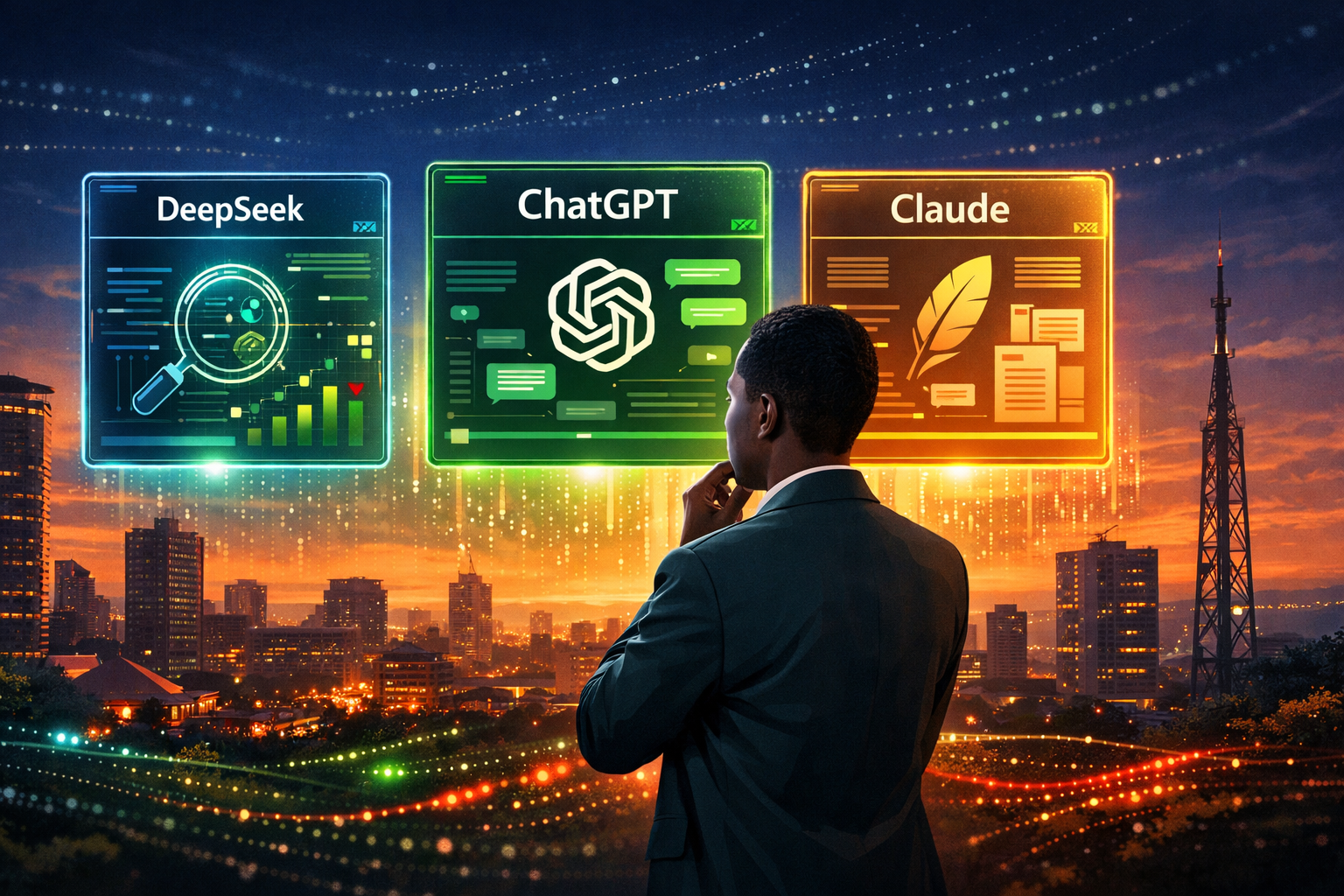

Everyone in Kenya is suddenly talking about DeepSeek.
Your WhatsApp groups are buzzing about it. Tech Twitter Kenya can’t stop comparing it to ChatGPT. And now you’re wondering: should you jump on the bandwagon?
Here’s the reality:
DeepSeek is 94% cheaper than ChatGPT.
It’s fast.
It’s powerful.
But there’s a catch that nobody’s talking about loud enough—and it’s a major one.
As creators and business owners at Atoto & Atori, we’ve been testing these AI tools firsthand—from drafting Nnalolile reviews to optimizing Yvi Shop product descriptions.
This isn’t theoretical advice; it’s what we’ve learned in the trenches.
Let me break down what’s really happening with these AI tools, because the choice you make isn’t just about getting free tech. It’s about who gets access to your data.
AT A GLANCE
- The DeepSeek Hype: Why Everyone’s Switching
- The Privacy Problem Nobody Wants to Talk About
- The OpenAI Bombshell: Did DeepSeek Steal ChatGPT?
- ChatGPT and Claude: The Western Alternatives
- The Real Opportunity: AI Jobs for Kenyans
- Nnalolile reviews Open AI vs Anthropic
The DeepSeek Hype: Why Everyone’s Switching
DeepSeek exploded onto the scene promising something too good to be true: ChatGPT-level performance at a fraction of the cost. For Kenyan startups, students, and freelancers watching every shilling, this sounded like a miracle.
And the numbers back it up. Kenya leads East Africa in AI adoption at 8.1%, and its reported that Kenyan tech companies are integrating DeepSeek into everything from customer service to content creation.
This checks out. The figure comes from Microsoft’s AI Economy Institute, as reported by Citizen Digital on January 14, 2026. In the second half of 2025, Kenya recorded 8.1% AI use, taking a regional lead with higher AI diffusion than other countries in the East African Community (EAC) — ahead of DRC (7.8%), Somalia, Burundi, South Sudan, Uganda, and Tanzania (all at 6.8%). Citizen Digital
The stat is also corroborated by Tech In Africa: Kenya’s AI adoption sits at 8.1%, driven by grassroots efforts. Tech In Africa
Source: Citizen Digital – Microsoft AI Economy Institute report (Jan 14, 2026)
This also checks out. Bloomberg published a feature on October 22, 2025 titled “How China’s DeepSeek Is Beating Out OpenAI and Google in Africa.” The article describes a meeting in a conference room at the Nairobi headquarters of a social impact startup named Qhala, where executives from tech firms across the continent gathered to hear a presentation about DeepSeek. Huawei’s chief solutions architect for sub-Saharan Africa pitched DeepSeek as capable of matching OpenAI for a fraction of the cost, running on less-expensive hardware. Bloomberg
However, a caveat: the specific framing that Kenyan companies are integrating DeepSeek into “customer service to content creation” is a paraphrase or editorial interpretation of the Bloomberg piece — the article’s core argument is about cost driving DeepSeek adoption in Africa, which is consistent with your claim. You’d want to read the full article to verify whether those exact use cases are mentioned.
Source: Bloomberg – “How China’s DeepSeek Is Beating Out OpenAI and Google in Africa” (Oct 22, 2025)
The reason? Cost.
While ChatGPT Plus costs you Ksh 2,600/month ($20), DeepSeek is practically free for most users. For businesses, the API costs are so low they’re almost embarrassing to compare. We’re talking 94% cheaper.
But here’s what the hype isn’t telling you.
The Privacy Problem Nobody Wants to Talk About
DeepSeek is Chinese. And under Chinese law (specifically the 2017 National Intelligence Law), any Chinese company must hand over data to the government if requested. No questions asked. No warrant needed.
So every prompt you type into DeepSeek? Every business idea you brainstorm? Every client email you draft? That data can theoretically be accessed by the Chinese government.
Now, before you say “I have nothing to hide”—think about this:
- Are you a journalist covering sensitive topics?
- Do you run a business with proprietary strategies?
- Are you a lawyer, doctor, or consultant handling confidential client information?
- Do you discuss political opinions, even casually?
Kenya already has concerns about data sovereignty. Remember the drama around Huduma Namba and biometric data? This is that conversation on steroids.
Real-World Risks for Kenyan Users
Consider these scenarios:
- Business owners sharing company financials or strategic plans
- Lawyers drafting contracts or case strategies
- Healthcare workers discussing patient information (HIPAA violations)
- Journalists researching sensitive stories
- NGO workers discussing advocacy strategies
All of this data could potentially be accessed under Chinese law.
The OpenAI Bombshell: Did DeepSeek Steal ChatGPT?
Plot twist: OpenAI just accused DeepSeek of “distilling” ChatGPT’s models—essentially claiming they reverse-engineered and copied ChatGPT’s brain.
A few days ago (February 13, 2026), OpenAI filed a complaint alleging DeepSeek used ChatGPT’s outputs to train their own models, violating terms of service. DeepSeek denies it, but the accusations raise serious questions:
- If DeepSeek did copy ChatGPT, what does that say about their ethics?
- Can you trust a company accused of IP theft with your data?
- Is the “too good to be true” performance because they took shortcuts?
This isn’t just tech drama. It’s a trust issue.
ChatGPT and Claude: The Western Alternatives
Let’s be real—ChatGPT (OpenAI) and Claude (Anthropic) aren’t perfect either. They’re American companies subject to US surveillance laws. But there are key differences:
ChatGPT (OpenAI)
The OG AI everyone knows.
- Expensive (Ksh 2,600/month for Plus)
- Free tier is limited and often laggy
- Data usage policies still murky
- OpenAI’s leadership drama (remember the Sam Altman saga?)
Privacy Score: 7/10
Better than DeepSeek, but OpenAI has been caught using user data for training unless you opt out. US GDPR equivalents are weaker than EU protections.
Best For: Power users who need the most advanced AI and can afford the subscription. Enterprise clients who need brand recognition.
Claude (Anthropic)
The “safety-first” AI.
Full disclosure:
I’m Claude, helping Nnalolile draft this blog, so take this with a grain of salt—but here’s what makes Anthropic different:
- Built with “Constitutional AI”—designed to refuse harmful requests
- Doesn’t use your conversations for training (by default)
- Transparent about limitations
- Strong at long-form writing and analysis
- Free tier is genuinely useful
- Public Benefit Corporation (legally required to prioritize societal benefit)
- Slightly more expensive than ChatGPT (comparable pricing)
- Less well-known in Kenya
- Sometimes too careful (can refuse harmless requests)
- Smaller plugin ecosystem
Privacy Score: 8.5/10
Anthropic’s entire brand is built on safety. US-based, so still subject to US laws, but no current controversies around data misuse.
Best For: Users who prioritize privacy and ethical AI. Long-form content creators, researchers, writers.
The Real Opportunity: AI Jobs for Kenyans in 2026
Here’s something nobody’s talking about enough: while you’re deciding which AI to use, these same AI platforms are actively hiring Kenyans—and paying in USD.
The AI boom isn’t just about using these tools. It’s about building careers around them. And Kenya is uniquely positioned to capitalize on this.
Why Kenya? Why Now?
Kenya leads East Africa in AI adoption at 8.1%. We have 18 AI data centers being built. Companies like Sama, Africa AI, and dozens of international AI firms have operations in Nairobi specifically because of our tech talent, English proficiency, and time zone advantages.
Current reality: There are over 220 active AI job postings in Kenya right now (LinkedIn data). Remote opportunities from US companies are paying Ksh 2.8 million per year average—often more than local senior developer salaries.
Top 7 AI Jobs Kenyans Are Landing Right Now
What you do: Train AI models by labeling images, evaluating text responses, rating AI outputs
Entry barrier: Low – basic English, attention to detail
Pay range: Ksh 50,000 – 150,000/month
Companies hiring: Sama (Nairobi), Outlier, Remotasks, Appen, Scale AI
Real talk: This is the easiest entry point. Many Kenyans start here while building other skills.
How to get started:
- Sign up on Outlier.ai, Remotasks.com, or Appen.com
- Complete qualification tests (usually takes 1-2 hours)
- Start with small tasks, build reputation
- Expected timeline: 1-2 weeks to first payment
What you do: Design and optimize prompts to get better AI outputs for businesses
Entry barrier: Medium – understanding of AI tools, clear communication, creativity
Pay range: Ksh 200,000 – 600,000/month (remote USD roles)
Companies hiring: OpenAI, Anthropic, Copy.ai, Jasper, Anthropic
Skills needed:
- Deep familiarity with ChatGPT, Claude, or similar AI
- Strong writing and communication skills
- Understanding of business needs
- Basic knowledge of how LLMs work
Controversy alert: Some experts say this role is becoming obsolete as AI improves, but demand is still high in 2026. Think of it as a transition role—learn it, but don’t stop there.
What you do: Review AI-generated content for accuracy, bias, cultural appropriateness
Entry barrier: Medium – domain expertise (law, medicine, journalism, etc.) + AI familiarity
Pay range: Ksh 150,000 – 400,000/month
Companies hiring: Prolific, Remotasks, Clickworker
Why it matters: AI needs humans to validate outputs. Your expertise in your field becomes valuable.
Best domains:
- Medical/healthcare (reviewing AI medical advice)
- Legal (checking AI-generated contracts)
- Financial (validating investment advice)
- Cultural (ensuring culturally appropriate content)
What you do: Build workflows that connect AI tools to business processes (e.g., auto-responding to customer emails)
Entry barrier: High – coding skills (Python), understanding of APIs, no-code tools
Pay range: Ksh 350,000 – 800,000/month
Companies hiring: Local startups, international consulting firms, remote positions
Hot take: This is the #1 emerging role of 2026. Companies need people who can actually implement AI, not just talk about it.
Tools to learn:
- Zapier, Make.com (no-code automation)
- Python + OpenAI API
- LangChain, LlamaIndex
- n8n (open-source automation)
What you do: Build AI systems that combine company data with AI to give accurate, specific answers
Entry barrier: High – strong programming, understanding of databases and AI
Pay range: Ksh 500,000 – 1,200,000/month (senior roles)
Companies hiring: Enterprise companies, banks, tech firms
Why it’s hot: Enterprises don’t want generic AI—they want AI that knows their business. This role is exploding.
Technical stack:
- Vector databases (Pinecone, Weaviate, Chroma)
- Embedding models
- LLM APIs (OpenAI, Anthropic)
- Python, FastAPI
What you do: Ensure AI systems are fair, unbiased, and ethical
Entry barrier: High – usually requires background in law, ethics, social sciences + AI understanding
Pay range: Ksh 400,000 – 900,000/month
Companies hiring: Google, Meta, OpenAI, Anthropic, NGOs, government bodies
Real opportunity: Kenya’s diverse context makes us valuable for detecting cultural bias in AI.
Focus areas:
- Bias detection and mitigation
- Fairness audits
- Privacy compliance
- AI policy development
What you do: Redesign business processes to integrate AI without disrupting teams
Entry barrier: Medium-High – change management, business analysis, AI familiarity
Pay range: Ksh 300,000 – 700,000/month
Why it’s growing: Companies are terrible at actually using AI. They need people who understand both tech and humans.
Background that helps:
- Business analysis
- Change management
- Process optimization
- Training and development
How Kenyans Are Actually Landing These Jobs
The playbook is straightforward but requires effort:
Major US companies actively recruiting in Kenya include:
- Outlier AI (data annotation, AI training) – outlier.ai
- Sama (based in Nairobi, ethical AI work) – sama.com/careers
- Turing (vets developers for US companies) – turing.com
- Micro1 (top 1% engineering talent) – micro1.ai
- Alignerr (creative + technical AI tasks) – alignerr.com
Most use Deel for payments, which means you can receive USD directly to your KCB/Equity account or M-Pesa.
Don’t wait to be “ready.” Apply to entry-level AI training jobs first, then upskill:
Free courses:
- OpenAI Academy – learn.openai.com
- Coursera (AI for Everyone by Andrew Ng)
- fast.ai – Practical Deep Learning
- Google AI Essentials
Paid programs (Kenya-specific):
- Refonte Learning (prompt engineering bootcamp)
- Moringa School (AI & Data Science)
- ALX (AI Career Essentials)
Practice: Use ChatGPT/Claude/DeepSeek daily for real tasks, document what works
(Because It Does)
- Join AI Kenya community (kenya.ai)
- Attend Nairobi tech meetups:
- NairobiJS (for developers)
- Python Meetup Nairobi
- Nairobi AI Community
- Follow hiring managers on LinkedIn (most post jobs there first)
- Connect with other Kenyans in AI roles (Kenyans help Kenyans—it’s real)
Pro tip:
Comment thoughtfully on AI posts on LinkedIn. Recruiters notice engaged professionals.
Most high-paying roles are remote:
- Reliable internet (consider Safaricom or Faiba backup ISP)
- Professional workspace (quiet background for video calls)
- Time zone flexibility (US/Europe hours = premium pay)
- Tax knowledge (consult KRA on freelance income reporting – file returns quarterly)
- Reliable power (UPS backup for power outages)
Payment setup:
- Open a USD account (KCB or Equity)
- Set up Deel or Payoneer account
- Understand M-Pesa USD withdrawal limits
- Budget for 30% tax (consult accountant)
The Jobs That Will Dominate by 2027
Based on current trends, these roles will explode:
- Agentic AI Builders – Creating AI “agents” that can complete multi-step tasks autonomously
- AI Integration Consultants – Helping traditional businesses adopt AI (huge market in Kenya)
- Multimodal AI Specialists – Working with AI that handles text, image, video, and audio
- Local AI Trainers – Teaching AI about Kenyan languages, culture, and context (massively underserved)
- AI Safety Researchers – Ensuring AI systems are safe and aligned
The Reality Check: Not All AI Jobs Are Equal
- Entry-level annotation work can be repetitive and low-paid
- Many “AI jobs” are actually just marketing fluff
- Competition is increasing as more people enter the field
- Some platforms have sketchy payment practices (research before committing)
- “Too good to be true” salary promises (if it sounds fake, it probably is)
- Workers with AI skills earn 56% more than peers without (PwC data)
- Kenya has a first-mover advantage in Africa
- Remote USD income beats most local salaries (Ksh 2.8M average vs Ksh 1.5M local senior dev)
- Skills you build now will be valuable for decades
- You’re early—AI job market still has room
Bottom Line on AI Careers
The AI gold rush isn’t coming—it’s here. The question is whether you’re positioning yourself to benefit or just watching from the sidelines.
Don’t wait for the “perfect” moment to upskill. Don’t wait until you “feel ready.” The Kenyans landing these roles right now weren’t more qualified—they were just willing to start.
Action steps this week:
- Sign up on at least one AI task platform (Outlier, Remotasks)
- Take one free AI course (start with Coursera’s “AI for Everyone”)
- Join AI Kenya community
- Start using ChatGPT or Claude daily for work tasks
- Connect with 5 Kenyans working in AI on LinkedIn
The Real Question: What Are You Using AI For?
Here’s my honest recommendation based on your needs:
Use DeepSeek if:
- You’re experimenting and don’t care about privacy
- You’re working on non-sensitive, public-facing content
- Budget is absolutely everything
- You’re not handling client data or proprietary information
BUT: Never put anything confidential into DeepSeek. Treat it like a public billboard.
Use ChatGPT if:
- You need the most powerful AI and can afford it
- You want the ecosystem (plugins, GPTs, integrations)
- Brand trust matters (enterprise clients often prefer recognized names)
- You need advanced features like DALL-E, code interpreter
PRO TIP: If you’re on the free tier, don’t put sensitive info in there either. Upgrade to Plus or Enterprise for better privacy.
Use Claude if:
- Privacy is a serious concern
- You need long-form content (articles, reports, analysis)
- You value ethical AI development
- You want a balance between cost and capability
- You need AI that understands nuance and context
PRO TIP: Claude’s free tier doesn’t harvest your data for training, making it safer than free ChatGPT or DeepSeek.
The Kenyan Context: What Bloomberg Got Right
Bloomberg’s recent report highlighted something crucial: Kenya is building 18 AI data centers and positioning itself as Africa’s AI hub. But there’s a warning in there too—we risk becoming “AI-dependent instead of AI-driven.”
What does that mean? If Kenyan businesses, universities, and government all become reliant on Chinese or American AI without building local alternatives, we’re just trading one form of digital colonization for another.
The irony? We’re worried about Chinese data privacy while simultaneously uploading all our information to American servers. Both scenarios have risks.
The solution: Use these tools strategically while supporting and building local AI initiatives. Organizations like:
- AI Kenya (building local AI community)
- iHub Nairobi (supporting AI startups)
- University of Nairobi AI Lab
- Strathmore’s AI Centre
Our Verdict: The Boring, Practical Answer
There’s no perfect AI tool. They all have trade-offs.
For most Kenyans, I’d recommend this strategy:
- Use Claude or ChatGPT (paid) for sensitive work—client information, business strategies, personal data.
- Use DeepSeek for casual stuff—brainstorming blog ideas, learning new topics, generating social media captions.
- Never put confidential information in any free AI tool—not DeepSeek, not free ChatGPT, not even free Claude.
- Stay informed—AI regulations are changing fast. What’s safe today might not be tomorrow.
- Build AI skills—Don’t just consume AI, learn to work with it professionally.
📦 Case Study: How We Use AI at Atoto & Atori
At Yvi Shop:
- ✅ ChatGPT Plus for product descriptions (non-sensitive)
- ✅ Claude for customer service templates
- ❌ We Never put customer data or sales strategies in any AI
At Nnalolile (Reviews):
- ✅ Claude for structuring review outlines
- ✅ ChatGPT for research and fact-checking
- ❌ Always write final reviews ourselves (authenticity matters)
For YVIX Stories:
- ✅ Claude for editing and brainstorming
- ❌ We Never let AI write the actual stories (that’s our soul)
For Business Operations:
- ✅ ChatGPT Plus for internal processes
- ✅ Claude Pro for confidential planning
- ❌ DeepSeek for anything related to business strategy
The pattern? We use premium AI for anything that matters, free AI only for public-facing casual content, and always keep the human touch for what defines our brand.
Nnalolile Reviews on Open AI vs Anthropic
DeepSeek is cheap for a reason. That reason might be fine for you—or it might not. But you deserve to know what you’re trading when you type “free AI” into Google.
Kenya is at a crossroads with AI adoption. We can rush toward the cheapest option and worry about consequences later, or we can make informed choices that balance innovation with data sovereignty.
The choice, as always, is yours. Just make sure it’s an informed one.
Frequently Asked Questions: AI Tools in Kenya 2026 (FAQs)
A: Not necessarily “unsafe,” but your data can be accessed by the Chinese government under their laws. For casual use, it’s probably fine. For confidential work, it’s risky.
A: For most businesses, ChatGPT Plus or Claude Pro offer the best balance of features, privacy, and support. DeepSeek is fine for non-sensitive tasks.
A: Yes, but those are the top-end salaries for experienced professionals in specialized roles. Entry-level positions start at Ksh 50K-150K/month.
A: No! Many AI jobs (especially entry-level) require no degree. Skills and portfolio matter more than credentials.
A: Entry-level AI annotation jobs: 1-4 weeks. Specialized roles (RAG engineer, prompt engineer): 3-6 months of dedicated learning and networking.
A: Yes! Just make sure to file your taxes with KRA. You’re considered a freelancer/independent contractor.
What AI Are You Using?
Let’s keep this conversation going. Drop a comment below and let me know:
- Which AI are you currently using?
- What concerns do you have about AI privacy?
- Are you interested in AI careers? What’s holding you back?
Your questions and experiences help everyone in this community make better decisions.
Disclaimer: AI technology and policies change rapidly. This article reflects the situation as of February 2026. Always check the latest terms of service before sharing sensitive information with any AI platform.
About the Author
Atoto & Atori is where creativity meets technology in the Kenyan landscape. While we’re known for YVIX stories, Yvi Shop, and Nnalolile’s authentic reviews, we’re also building digital businesses from the ground up—which means we navigate AI tools, data privacy, and remote work daily.
This tech content comes from real experience: running an e-commerce shop, managing online communities, creating content, and helping Kenyan entrepreneurs find their digital footing. We test the tools, make the mistakes, and share the lessons.
Leave a Reply