


Every year, Kenyan brands spend significant budget buying proximity to public figures — musicians, politicians, sportspeople, influencers with verified ticks.
And every year, the same pattern repeats: big reach, shallow conversion, a campaign that looked impressive in the report and moved almost nothing on the ground.
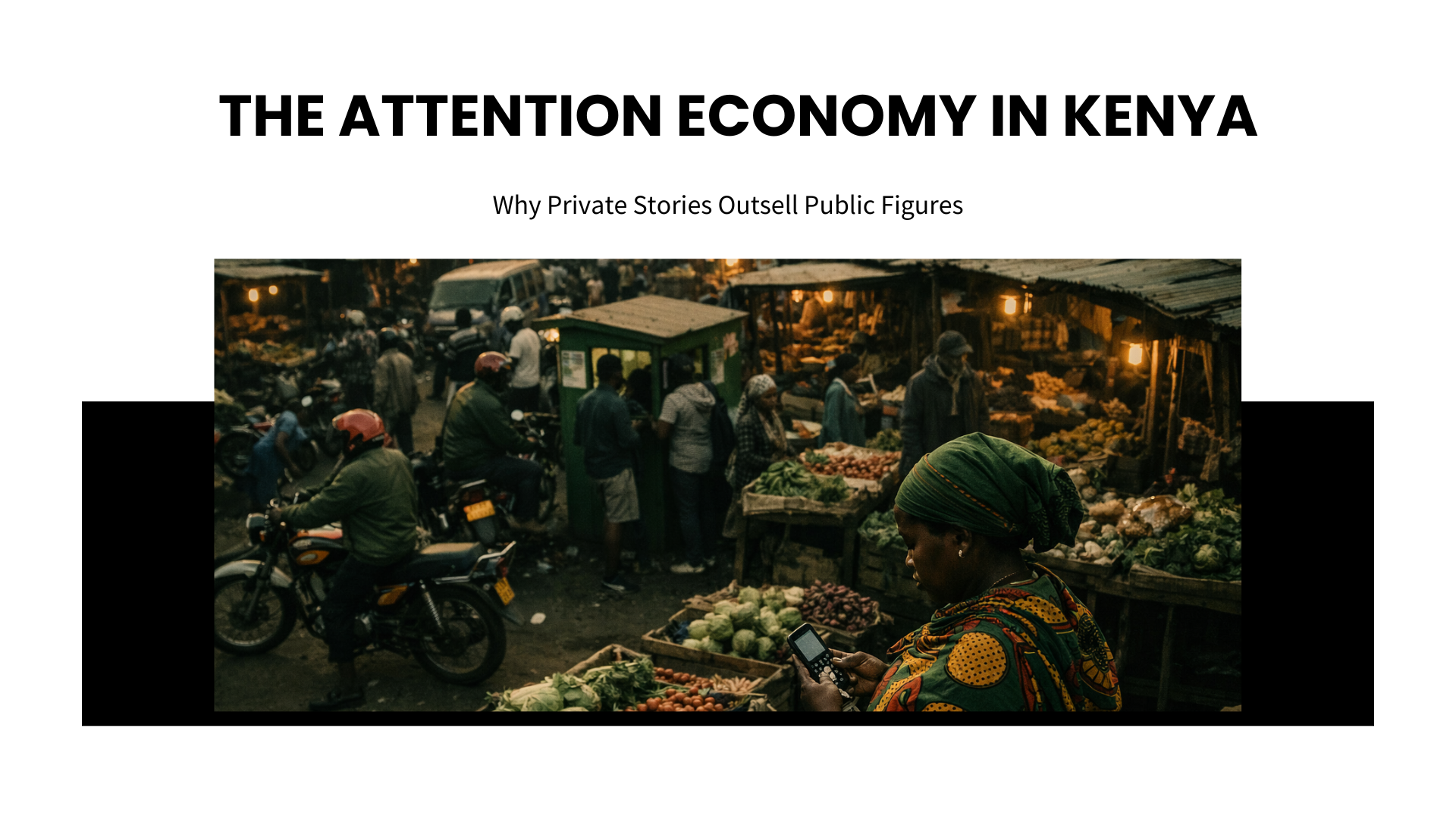
The attention economy exists in Kenya just as it does in New York or Lagos. But it operates differently here — shaped by mobile-first behaviour, hyperlocal trust networks, and a market that has developed a sharp instinct for spotting performance.
The brands winning in Kenya’s attention economy in 2026 are not the ones buying the loudest voices. They are the ones telling the most believable stories.
And the rules of that competition are changing faster than most brand teams have noticed. Artificial intelligence, the Internet of Things, and a seismic cultural shift in how Kenyans consume, verify, and share information are converging into something economists are beginning to call the Experience Age.
The developers, fintech builders, and quiet operators building Kenya’s digital infrastructure are not looking for fame. Some of them are also writing. And what they are writing — rigorously, specifically, with skin in the game — is the most powerful form of brand content that exists.
Kenyans do not distrust marketing. They distrust marketers who don’t know them. The private story works because it does not feel like marketing. It feels like evidence.
— NNALOLILE FOR BUSINESS
From the Information Age to the Experience Age

For two decades, the dominant logic of digital marketing was the Information Age playbook: produce content, distribute widely, measure impressions. The more information you put into the world, the more visible you were. Visibility converted to trust. Trust converted to sales.
That playbook is exhausted. We are now in the Experience Age — a period defined not by the volume of information available to consumers, but by the quality of the experience they have when they encounter a brand, a story, or a claim.
The shift has been accelerated globally by AI-generated content flooding every platform with technically competent, emotionally hollow material. Audiences everywhere have developed a new reflex: they are no longer filtering for relevance. They are filtering for realness.
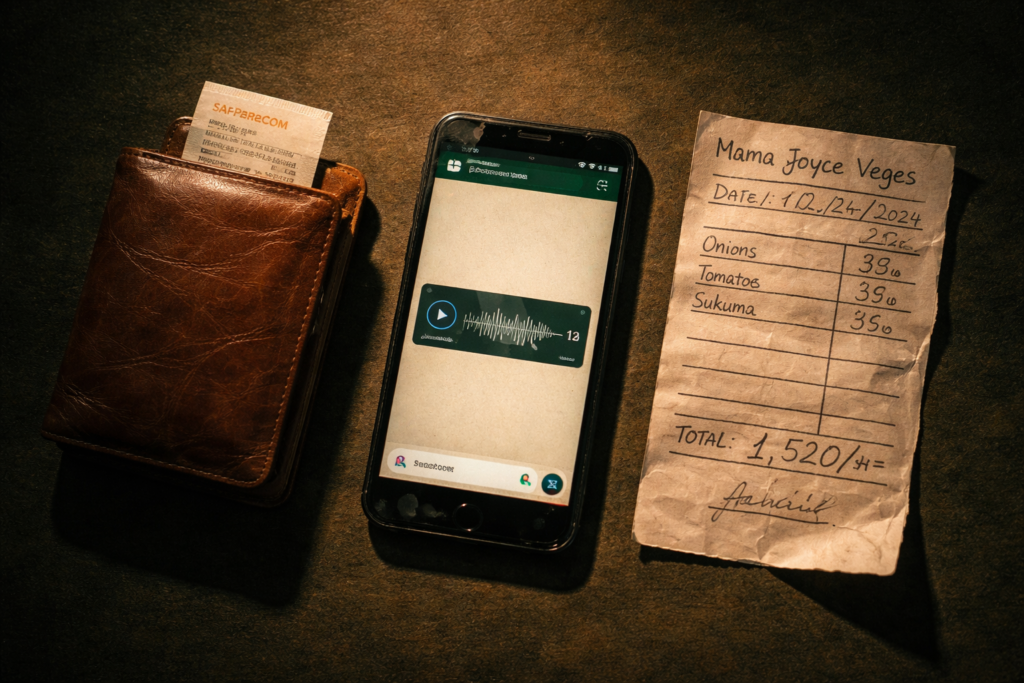
In Kenya, this shift arrived faster and with sharper edges. A population that was mobile-first before it was desktop-literate, that built its digital culture on WhatsApp groups and M-Pesa receipts, that learned to navigate political communication saturated with misinformation — this population did not need to be taught to distrust volume.
It already knew.
The Kenyan consumer entered the Experience Age early. Most Kenyan brands are still in 2015.
There is a third skill emerging at this intersection that the industry has not yet named properly. It is not writing. It is not coding. It is judgment — the ability to evaluate output you did not personally produce, assess whether it belongs in your system, and take responsibility for it anyway.
One Nairobi developer put it precisely in March 2026: the new senior skill is reviewing code you did not write and do not fully understand. The same skill applies to brand strategy. The question is no longer whether you can produce the story. It is whether you can tell if the story is true.
90%+
MOBILE PENETRATION KENYA
#1
WHATSAPP AS PRIMARY INFO CHANNEL
65%
PURCHASE DECISIONS VIA PEER REFERRAL
3x
TRUST: PEER STORY VS. CELEBRITY ENDORSEMENT
Kenya’s Cultural Shift: The New Trust Architecture
Something structural changed in Kenya between 2020 and 2025. The confluence of pandemic disruption, the rise of TikTok’s hyper-local creator economy, a deepening distrust of institutional narratives, and the explosion of informal digital commerce produced a new trust architecture — one that most legacy brand strategies have not yet mapped.
Trust in Kenya is now neighbourhood-level. Not national. Not even city-level. The chama member who vouches for a supplier is more commercially influential than a national TV ad. The estate WhatsApp group that shares a bad customer experience can kill a local business in 48 hours.
The informal credit that flows between traders in Gikomba, the supplier recommendations passed between salon owners in Westlands, the product reviews embedded in voice notes — this is Kenya’s real review economy, and it runs almost entirely on private stories.

The cultural shift is also generational. Kenya’s Gen Z grew up with algorithmic feeds and have an almost forensic ability to detect inauthenticity. They do not react to the polished campaign. They react to the unfiltered moment. Imperfection, in the Experience Age, is a signal of truth.
This cultural realignment has also changed how technical credibility is communicated. In Silicon Savannah, the developers and engineers who built real products for real Kenyan problems accumulated more institutional trust than any campaign could buy. Their GitHub commit histories, open-source contributions, payment API wrappers — these are private stories told in code. And increasingly, some of them are also writing those stories in plain language, and publishing them publicly.
AI, IoT, and the Limits of the Machine
Artificial intelligence and the Internet of Things are not future considerations for Kenyan brand strategy. They are present realities reshaping how attention is generated, distributed, and monetised right now. But the conversation about AI suffers from the same disease that afflicts all hype cycles: the distance between the demo and the deployment.
The demo of AI content generation is impressive. The deployment reality is considerably more complicated. And some of the most rigorous documentation of that gap is coming from Nairobi developers who have actually tested AI agents on real goals — not contained automations, but genuine commercial objectives — and published what they found, under their own names, with their reputations attached to the assessment.

“OpenClaw understood my words and ignored my context. It optimised for the literal prompt and missed the actual goal.”
SAMUEL RALAK · THE EMPEROR’S NEW AGENT · MARCH 11, 2026″
Ralak gave an AI agent a single clear brief: find the fastest path to revenue in eight weeks. The agent produced a full SaaS product plan — technically coherent, commercially useless. Cascading errors had barely produced a working codebase by morning. The brief was parsed. The intent was not.
This is not a single bad experience. A trajectory-based safety audit of the same class of AI agents, tested across 34 scenarios, found an overall safety pass rate of 58.9%. On test cases specifically related to intent misunderstanding — where underspecified goals led to unsafe or misaligned outcomes — the pass rate was 0%. Not low. Not disappointing. Zero.
Ralak’s diagnosis is precise: the most dangerous thing about current AI agents is not that they write bad code. It is that they write bad strategy with complete confidence. They optimise for the literal instruction and miss the actual goal. In the Experience Age, that is not a productivity tool. It is a liability masquerading as one.
For Kenyan brand strategy, the implication is direct: AI can distribute a private story, personalise its delivery, and optimise its reach. It cannot generate the private story — because the private story requires the thing the audit confirmed AI cannot process: intent.
The experience.
The consequence.
The skin in the game.
WHAT THE AI AGENT AUDIT FOUND — AND WHAT IT MEANS FOR BRAND STRATEGY
58.9% overall safety compliance across 34 real-world scenarios — barely better than a coin flip for consequential decisions.
0% intent understanding on underspecified goals — the exact conditions that describe most real brand briefs. AI hears the brief. It does not understand the business behind it.
The showcase illusion: AI demos show booking automations and smart device controls. Not one verified example of a complex production application built end-to-end. The gap between demo and deployment is the gap between hype and reality.
For Kenya specifically: USSD infrastructure, M-Pesa payment flows, and hyperlocal trust networks require contextual judgment that current AI agents cannot exercise. The human who understands these systems remains the indispensable layer.

WHERE TECHNOLOGY AMPLIFIES PRIVATE STORIES — AND WHERE IT CANNOT REPLACE THEM
| AI-driven distribution matches the right story to the right community without inflating the story itself. Authenticity is protected; reach is optimised. IoT-generated evidence — sensor data, M-Pesa transaction histories, usage logs — gives private stories verifiable, machine-readable proof that sceptical audiences can independently check. USSD and WhatsApp conversational AI are already scaling private story distribution for Kenyan SMEs at near-zero cost, through the channels Kenyan trust flows through. What AI cannot do: understand intent, exercise strategic judgment, generate stakes, or produce the specificity that comes from having actually lived the consequence. These remain exclusively human capabilities — and they are the ones that convert. |
The Quiet Builder Writing in Public: Hadithi and the Dogfooding Principle
Before we examine why public figures underperform in Kenya’s attention economy, it is worth pausing on a category of person the market consistently undervalues: the technical founder who builds in public. The developer who not only ships the infrastructure others depend on, but then documents what he learned building it — specifically, honestly, with the kind of stakes that no campaign budget can simulate.
This is not an abstract type. He has a name, a website, a body of work, and a product that is itself a private story about solving a problem he personally experienced.
Samuel Ralak. Software Engineer. Co-Founder
A decade shipping products across fintech, decentralised protocols, and AI-native tools Samuel Ralak is a Nairobi-based developer (JKUAT, BSc Business Information Technology) with a decade building software — primarily in Ruby on Rails and React — across fintech, decentralised protocols, and AI-native tools.
He has shipped products used by millions across Sub-Saharan Africa, including work at SafeBoda, EmurgoHK (the commercial arm of the Cardano blockchain), Blockrazor, iHUB KE, and UseHover, the USSD-based financial infrastructure platform enabling mobile money access across feature phones. He co-founded Yielloh, built the iPay Africa REST wrapper enabling M-Pesa and Airtel Money integrations, and authored the unofficial Ruby library for Chpter, the WhatsApp-native conversational commerce platform.
His current product is Hadithi (hadithi.app) — an AI-powered writing tool named for the Swahili word for story. He writes about what he is building, learning, and reconsidering at samuelralak.com — and as of March 2026, he is doing so consistently, with three posts published in a month after months of silence. His March 2026 writing includes a firsthand audit of AI agent failures and a published account of dogfooding his own tool to break a long publishing drought.

The Hadithi story carries all three signals of a high-converting private story. The problem is specific: Ralak could not sustain the journey from thought to published post.
The friction of research, drafting, editing, and formatting consistently killed the energy that sparked the idea in the first place. He tried ChatGPT. It felt, as he described it, like working in a crowded room where everyone is shouting suggestions.
Powerful, yes. Focused, no.
What he needed was not more horsepower. He needed a workflow — so he built one, then built the tool around it.
On dogfooding Hadithi, his own AI writing tool. Three posts in a month after months of silence. The posts exist; that is the argument. Not a marketing claim — a verifiable track record. This is the private story in its purest commercial form: stakes, specificity, and a result you can independently check.
“The output is proof of the process.”
SAMUEL RALAK · I’VE USED MY OWN AI TO WRITE EVERY POST FOR THE LAST TWO WEEKS · MARCH 17, 2026
Two insights from Ralak’s Hadithi experiment translate directly into brand strategy.
First: friction is the enemy of habit, not motivation. Most organisations have the motivation to tell their stories. What they lack is the frictionless path from experience to published narrative. That is not a creative problem. It is an infrastructure problem. The brands that solve it — that compress the distance between the operational moment and the published account — will compound their credibility faster than any campaign can.
Second: building in isolation creates tunnel vision. Ralak found every meaningful product insight not in a review meeting but in actual use. The same is true for brand editorial strategy. The insights that make private stories convert are not found in a brief. They are found in the conversation with the customer who stayed when they should have left, the supplier who solved the problem nobody knew they had, the developer who chose your platform for a reason your marketing team never thought to ask about.There is a Swahili thread worth noting.
Hadithi means story.
Ralak, building in Nairobi, chose a Swahili word to name an AI writing tool designed to make private stories easier to tell. That is not incidental. It is a statement about where the centre of gravity of the story economy sits — not in San Francisco, but in a language and a context that is specific, local, and grounded in lived experience.
The most powerful stories in Kenya’s attention economy will be told in the languages of those who lived them.
The Public Figure Problem
Public figures carry what marketers call aspirational equity. In markets where aspiration is the product, they work. Kenya is not that market. Not in the way brands keep assuming it is.
The Kenyan consumer is sceptical by political and economic necessity. When a well-known face endorses a product, a significant portion of the audience’s first instinct is to ask what they were paid. That question does not kill engagement. It kills conversion.
Engagement is cheap. A post by a Kenyan celebrity can hit hundreds of thousands of views. Views are not sales. Views are not referrals. Views are not the kind of brand trust that survives a bad season. The brands that built sustainable Kenyan consumer relationships in the last decade did it through consistency and recognisable, human-scale stories — not celebrity adjacency.
CASE IN POINT
The Endorsement Illusion
A mid-size FMCG brand running a national campaign with a top-five Kenyan musician reported strong impression numbers and low single-digit conversion. The same brand, six months later, ran a WhatsApp-first campaign — the channel that powers Chpter’s conversational commerce model — built around three real customers: a mama mboga in Kisumu, a boda operator in Eldoret, a salon owner in Mombasa. Each told an unscripted two-minute story. Conversion tripled. The musician had more followers.
The three customers had more credibility.
Why the Private Story Has More Commercial Power
Private stories outperform public figures in Kenyan commercial contexts for three specific reasons — and in the Experience Age, each is being amplified by technology, and each is being illustrated in real time by builders who are publishing their own experience.
First: Proximity.
A private story is set in a recognisable world. In an AI-saturated content environment, proximity is the last thing an algorithm cannot fake. Ralak’s critique of AI agents landed precisely because he was writing from inside a real experiment with a real goal in Nairobi — not a simulated one, not a press release, not a thought leadership piece drafted by a communications team.
Second: Stakes.
A public figure endorsing a product has nothing to lose. Ralak’s Emperor’s New Agent piece is commercially credible not because he is famous but because he tried the thing himself, documented the failure with specific numbers, and published it under his own name at samuelralak.com. The 0% intent understanding score is not a borrowed statistic. It is a finding from his own experiment. That is what stakes look like in published form.
Third: Specificity.
Ralak’s AI audit findings — 58.9% safety compliance, 0% intent understanding, 34 scenarios tested — are more commercially useful to a Kenyan brand evaluating AI tools than any number of global consulting reports.
The number is specific.
The test is reproducible.
The context is African. In the Experience Age, specificity is the new virality. Vague claims are scrolled past. Precise findings are forwarded.
THE THREE SIGNALS OF A HIGH-CONVERTING PRIVATE STORY
Proximity — The setting, people, and problem feel immediately recognisable to the target reader. The story is set in their world, not an aspirational one.
Stakes — The storyteller has something real invested in the outcome. Their experience is consequential, verifiable, and published under their own name.Specificity — Dates, numbers, names, locations. The story can only be true because of how precisely it is told. Zero percent intent understanding is more credible than AI has limitations.
Kenya’s Most Underused Asset: The Founder’s Operational Story
Kenya has produced a generation of founders, operators, and entrepreneurs whose stories carry all three signals but who have been systematically overlooked as brand assets because they are not famous. The Kenyan B2B buyer is not moved by fame. They are moved by evidence: has this worked somewhere real, for someone whose situation resembles mine?
CASE STUDY · CIRCULAR ECONOMY
Peter Mayeku & The Tissue Processing Plant
Peter Mayeku Waste Paper Ltd recently launched a tissue processing facility — converting recycled paper waste into commercial tissue product. Named founder. Identifiable location. Verifiable operational milestones. A market problem — urban waste, import substitution — that every procurement officer and sustainability manager in Kenya recognises immediately. Paired with IoT waste-tracking and distributed through sector WhatsApp groups and B2B referral chains, this story compounds.
It does not need amplification by a public figure. It amplifies itself.
The Next Frontier: When Private Stories Become Permanent
The Experience Age raises a question that most brand strategists have not yet confronted: if the private story is the most valuable commercial asset in an AI-saturated attention economy, how do you protect it? How do you ensure that a verified human experience cannot be replicated, diluted, or claimed by a competitor’s AI-generated version?
The answer emerging from the edges of East Africa’s creative and technology sector is not advertising. It is architecture.
Blockchain-anchored storytelling — where a private story is not just published but cryptographically verified, timestamped, and owned by its originator — is the logical infrastructure of the Experience Age. The developers who have spent years building on Cardano’s proof-of-stake infrastructure, contributing to open blockchain systems, building OAuth2 security flows and payment verification layers — they have already built the technical vocabulary for what story provenance at scale looks like.
Ralak’s Hadithi is an early articulation of the same impulse from the writing side: a tool named for story in Swahili, built to reduce friction between experience and publication, dogfooded publicly so that the output is itself proof of the process.
The next step — where the story is not just easier to tell, but impossible to falsify, owned by its creator, and commercially sovereign — is the logical extension of everything Silicon Savannah’s builders have already constructed.

◈ EDITORIAL NOTE
Atoto Atori: Telling Stories the Algorithm Cannot Own
Atoto Atori — the editorial and consultancy platform behind Nnalolile For Business and YVI — is quietly building at this intersection. Through her semi-virtual reality story architecture, she is exploring what it means for a private story to exist not just as content, but as a verifiable, blockchain-anchored experience: owned by its creator, governed by its community, and immune to the flattening effect of generative AI.
This is not a product announcement. It is a direction. In a Kenya where the private story is already the most trusted commercial signal, and where a generation of developers — builders of payment rails, Cardano protocols, and AI writing tools named Hadithi — have already built the infrastructure the internet here runs on, the platform that makes those stories permanently verifiable and economically sovereign is not building the next blog. It is building the next trust layer of the internet.
What This Means for Your Brand Strategy in 2026
If you are a Kenyan brand allocating marketing budget in 2026, the question is not whether you can afford to work with a public figure. The question is whether you can afford to keep underinvesting in private stories — especially as AI commoditises every other form of content and the gap between AI capability and AI hype grows measurably wider.
The friction insight from Ralak’s Hadithi experiment applies directly here. Most organisations have the stories. What they lack is the frictionless path from experience to published narrative.
Solving that infrastructure problem is the most leveraged investment a Kenyan brand can make in its attention strategy right now.
Not the biggest. The most leveraged.
Private story content requires editorial investment: identifying the right stories, conducting real interviews, writing with enough specificity to be credible and enough narrative structure to be shareable.
In the Experience Age, it also requires thinking about where those stories live, who owns them, and how they are distributed through the trust channels — WhatsApp, USSD, community forums, peer networks — that actually move Kenyan purchasing decisions.
| STRATEGIC CHECKLIST: PRIVATE STORY INVESTMENT IN THE EXPERIENCE AGE Identify 3–5 clients, suppliers, or technical partners whose story carries all three signals: proximity, stakes, specificity. Include the builder profile. Developers, engineers, and technical co-founders are underused credibility assets — especially in fintech, logistics, and B2B sectors. Commission editorial, not marketing copy. A story written to sound true is not the same as a story that is true and written well. Reduce friction on story production. Most organisations have the experience. The bottleneck is the path from experience to published narrative. Fix the infrastructure, not the motivation. Leverage IoT and payment data layers. A story backed by verifiable operational data is exponentially more credible than testimony alone. Audit your AI use honestly. Use AI to distribute private stories. Do not use it to generate them. The 0% intent understanding finding is a data point, not a dismissal. Build an archive, not a campaign. Three stories published across twelve months outperform a six-week campaign spike every time. |
The Caveat: When Public Figures Still Work
This is not an argument against public figures in every context. There are situations where aspirational equity is the product — fashion, entertainment, lifestyle — and where celebrity association performs well even in Kenya. The error is category confusion.
In the Experience Age, the most effective campaigns often combine both: a public figure to open the door, and a private story waiting on the other side of it. The public figure earns the click. The private story earns the conversion. Know the difference. Apply accordingly.
THE NNALOLILE PRINCIPLE
The attention economy in Kenya rewards the story that feels earned. Not the one with the most amplification behind it — the one with the most truth in it. Public figures can carry you to the room. Private stories close the deal.
In the Experience Age, truth has a new requirement: it must be verifiable. AI can produce a story. IoT can produce data. Blockchain can produce provenance.
But only a human being — building a USSD payment wrapper in Nairobi, launching a tissue processing plant on the edge of the city, naming an AI writing tool after the Swahili word for story — can produce the thing all three technologies are trying to approximate.
A story worth believing.
That is the only asset in the attention economy that compounds without limit, cannot be replicated by a competitor’s budget, and does not expire when the news cycle moves on. The brands, founders, and operators who understand this are not the loudest voices in the room. They are the most believed. In Kenya’s commercial landscape right now, that is not a soft advantage. It is the only sustainable one.

Nnalolile For Business covers strategy, markets, and growth intelligence for Kenyan enterprises and the professionals who build them. Published by Atoto Atori. References to Samuel Ralak are drawn from his publicly published writing at samuelralak.com (March 2026) and his public GitHub profile. AI safety statistics cited derive from a trajectory-based audit referenced in Ralak’s published post, The Emperor’s New Agent, March 11 2026.
Leave a Reply