The Clover and the Underground
On inherited doctrine, chosen faith, and the God who keeps appearing in the last place you were looking.
They gave me a script. Not all at once — that would have been too obvious. It came in layers, the way ivy grows on a wall: quietly, steadily, until one morning you look up and the wall is gone. You are just looking at ivy. And they call it architecture.
My parents had divorced years before. That rupture had pulled the family away from fellowship — not dramatically, not with a declaration, but the slow way things fall: one missed Sunday, then another, then the Sundays became a season and the season became years. The Christadelphians were always there at the ranch, reading their Bibles with their maps and their careful notes, and my father was one of them, but the family had fractured and the fellowship with it. My mother chose to remain outside — not out of unbelief exactly, but out of a loyalty the community could not always accommodate: she would not let doctrine be the thing that finished separating what the divorce had already broken. My sister never fully recovered from the abandonment that followed. The brethren look forward to having them both back, and I hold that hope too, quietly, without pressure, the way you hold something that is not yours to force.
What no one tells you about growing up in a believing household is that the doctrine gets into your bones whether you consent or not. My father re-reading his Bible at the corner table. Sis. Kaye — her kitchen utensils shipped from Canada, her voice telling the Gospel better than any chatbot I have since encountered, her husband now gone, her faith outlasting his absence in the way genuine faith tends to outlast everything. The ranch at Fana B. The brethren who did not have a church but a meeting, who read the same Book but arrived at it differently, quietly, without the chanting. I absorbed all of it. And then I left. And then life took me into its underground, as it does, and I discovered — the hard way, the only way — that what you absorb as a child is not the same as what you choose as an adult. That there is a difference between knowing the words and speaking from yourself. Between doctrine and faith. Between the script and the story you are actually living.
There is a difference between knowing the words and speaking from yourself. Between doctrine and faith. Between the script and the story you are actually living.
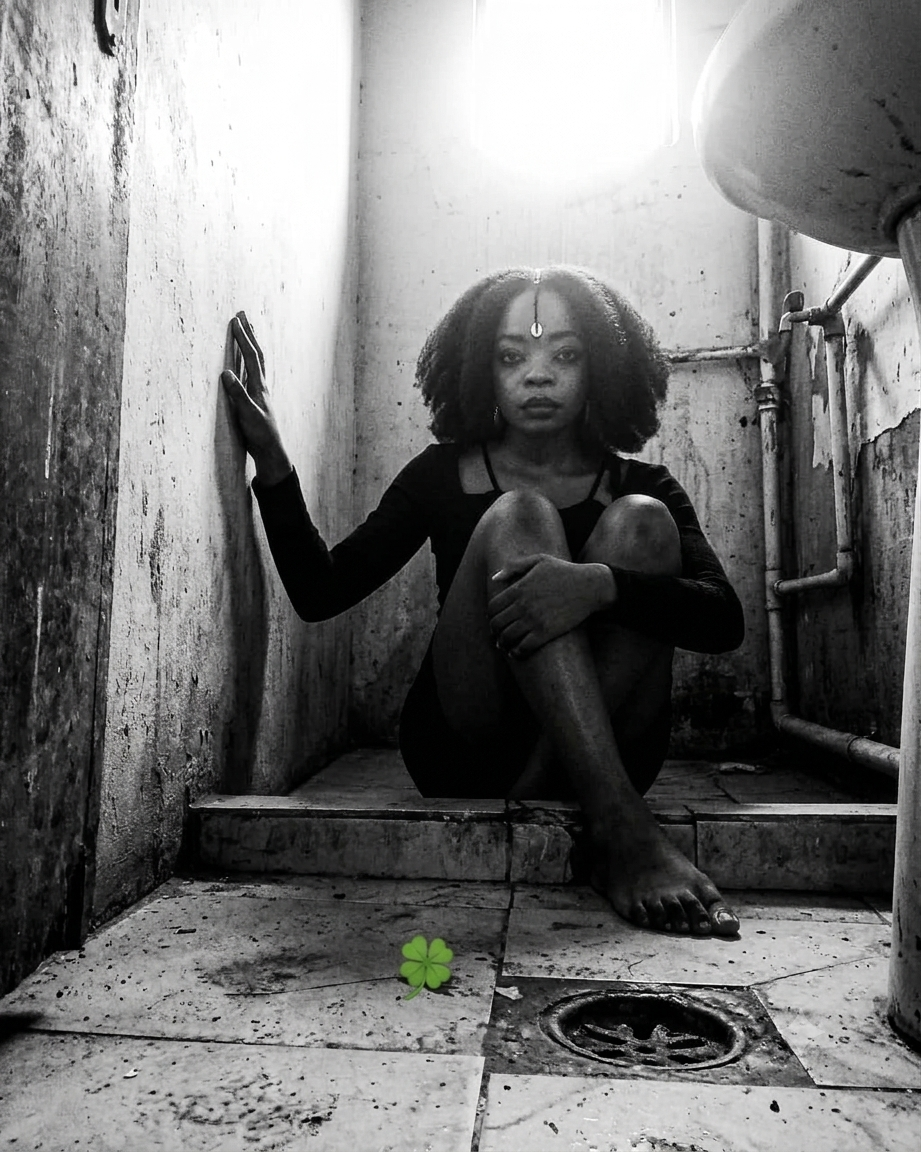
Before the YVIX writing. Before the baptism. Before I had words for any of it. I went into a bathroom — small, private, mine — and stayed there longer than bathrooms are meant to be used. I went in there to cry. Then I would dance, whatever was playing in my head, to move the pain out through the only exit it had. Then shower. Then, at the extremes, film myself and post it somewhere online, because there is a particular madness that comes over you when you are in enough pain: you want to be witnessed. Not saved. Not counselled. Just seen. Even by strangers in the digital dark who enjoy such things, and who did. In that bathroom the clover grew.
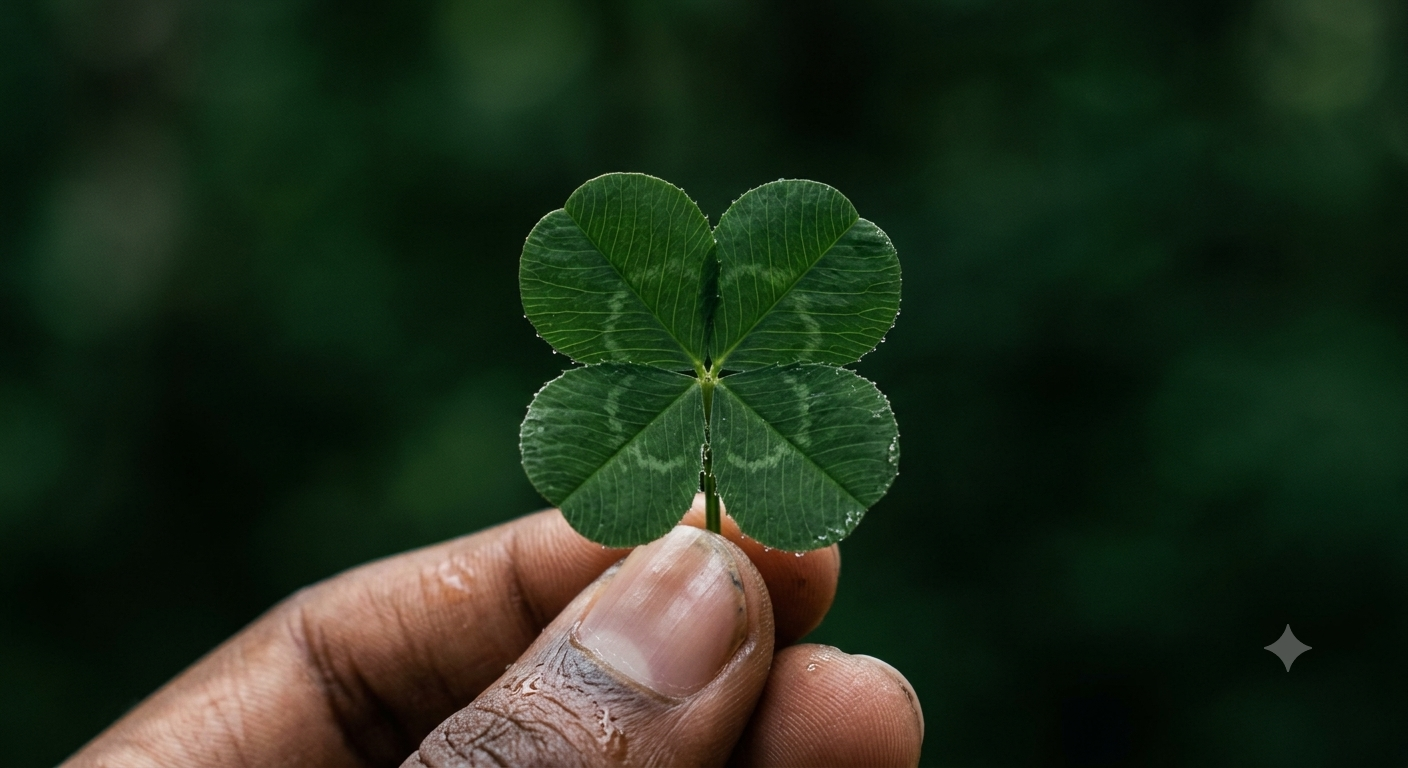
The first time, I picked it up alone and kept it. A four-leaf clover, in that bathroom, in the worst chapter I had yet lived. I grew up in a believing household and had, whether I admitted it or not, a cellular memory of the idea that Providence sends messages in strange containers. I kept it. Did not speak of it. Filed it away. The second time, I showed my father. He is a careful man, a Christadelphian with maps in his Bible and notes in the margins — not a man who makes claims about signs without checking the references. He looked at the clover. He did not offer an interpretation. He handed it back. And somehow that was the right answer — not because he failed me, but because this was not his sign to interpret. It was mine. God had not sent it to my father. God had sent it to me. The third time, I just kept it.
I read. This is what I do when the walls come in — I read the way other people drink, not for pleasure primarily, but for the specific relief of being inside someone else’s mind long enough to remember that minds other than my own exist and have survived their own underground passages. I read Gödel, Escher, Bach — Hofstadter’s strange loop, the idea that consciousness is a pattern that recognises itself, that meaning emerges from the recursive collision of systems that should not, by rights, produce meaning at all. Then I read Midnight’s Children — the banned one, pulled from various states, which naturally meant I had to understand why. Rushdie’s Saleem Sinai born at the precise stroke of independence, telepathically linked to every child born in that same midnight hour across a subcontinent — a whole generation bound together by the accident of when they arrived. What struck me was not the magic but the burden: to be connected to history in a way you never chose, to carry a story larger than yourself in a body that did not ask to carry it. I had been absorbing a story since childhood — in my father’s Bible margins, in Sis. Kaye’s voice, in the ranch at Fana B — and somewhere in Rushdie’s strange crowded novel I found myself being redirected, almost against my will, back to the one Book I actually trusted. Not the performance of it. Not the doctrines as a set of correct answers to be memorised and deployed. The actual text, with its actual strangeness — the fact that Jacob wrestled with God and won, that God let him win, and that this is presented as the preferred outcome. Not a cautionary tale about a man who overreached. A renaming. A blessing given precisely because the man refused to let go. The text does not explain this away or tidy it into a lesson about humility. It leaves it exactly as strange as it is: God, who made everything, choosing to be held by a human being until dawn, and then honouring the grip. That is not a God who wants performance. That is a God who wants encounter.
I reconnected with Sis. Kaye. That chain of naming — her name to my mother, my mother’s name to me — was also a chain of something less visible: a way of being curious about God rather than merely certain about God. I started travelling with the Bereans across Africa, not to perform fellowship but to sit and read and ask questions among people who had arrived at the same faith through entirely different underground passages.
But all those stories — Gödel’s loops, Rushdie’s midnight children, Jacob refusing to release his grip — are fragments of proof that drive my soul. If they are true, so is Psalm 127. And I choose to receive it that way: I choose to be my Father’s beloved, the child to whom something is given in sleep, not as idleness but as inheritance. The one who does not have to claw for what Providence has already named theirs. This is not passivity — it is the opposite of it. It is the refusal to let poverty of spirit, or poverty of circumstance, or the slow pressure of lack, rewrite the terms of the promise. I have watched what happens when you let those things do the rewriting. I will not.
During my last trips to Malawi, the brethren put me to a test too. They asked me to explain Hebrews 1:13 — why God did not choose any of his angels to sit at his right side. The conversation happened in Chichewa, which is its own kind of experience: a language that moves like Swahili but with something else woven into it, something rounder, softer, a different music underneath. My Chichewa is not fluent. But there was a brother there who became, in real time, the strangest kind of translator — I would explain the text the way you explain something to a child, stripping it all the way down to the bones of it, and he would take what I had said and run it through an AI tool and bring it back across the language. Which sounds undignified. Which was, in fact, the most honest thing I have seen in a fellowship meeting. No performance. Just the actual work of getting understanding from one mind to another by whatever route it takes.
And that is when I thought about Pentecost properly, perhaps for the first time. The disciples spoke, and the crowd heard — each in their own language, without anyone switching tongues. The text does not say the disciples spoke in every language. It says the people heard in theirs. Which means the miracle was not in the speaking. It was in the receiving. The disciples were just being themselves, saying what they knew in the only voice they had — and something in the transmission, something between the mouth and the ear that is not in any grammar book, carried the meaning across. That is not so different from what happened in that room in Malawi. I spoke in the language I had. The brother translated. The AI translated the translation. And the brethren understood. The route was undignified. The arrival was real.
I have thought about that question — Hebrews 1:13 — more than they perhaps intended me to. It aligns with Proverbs 22:6, in a way that took me a while to see: train up a child in the way he should go, and when he is old he will not depart from it. The right-hand seat was not given to an angel because an angel was never a child who had to choose. An angel was never broken in an underground passage. An angel was never on a bathroom floor, or in a hostile high-rise, or in a Nairobi meeting room making arguments no one asked for. The right-hand seat went to the one who went through all of it and stayed. That is not a lesson about hierarchy. It is a lesson about formation.
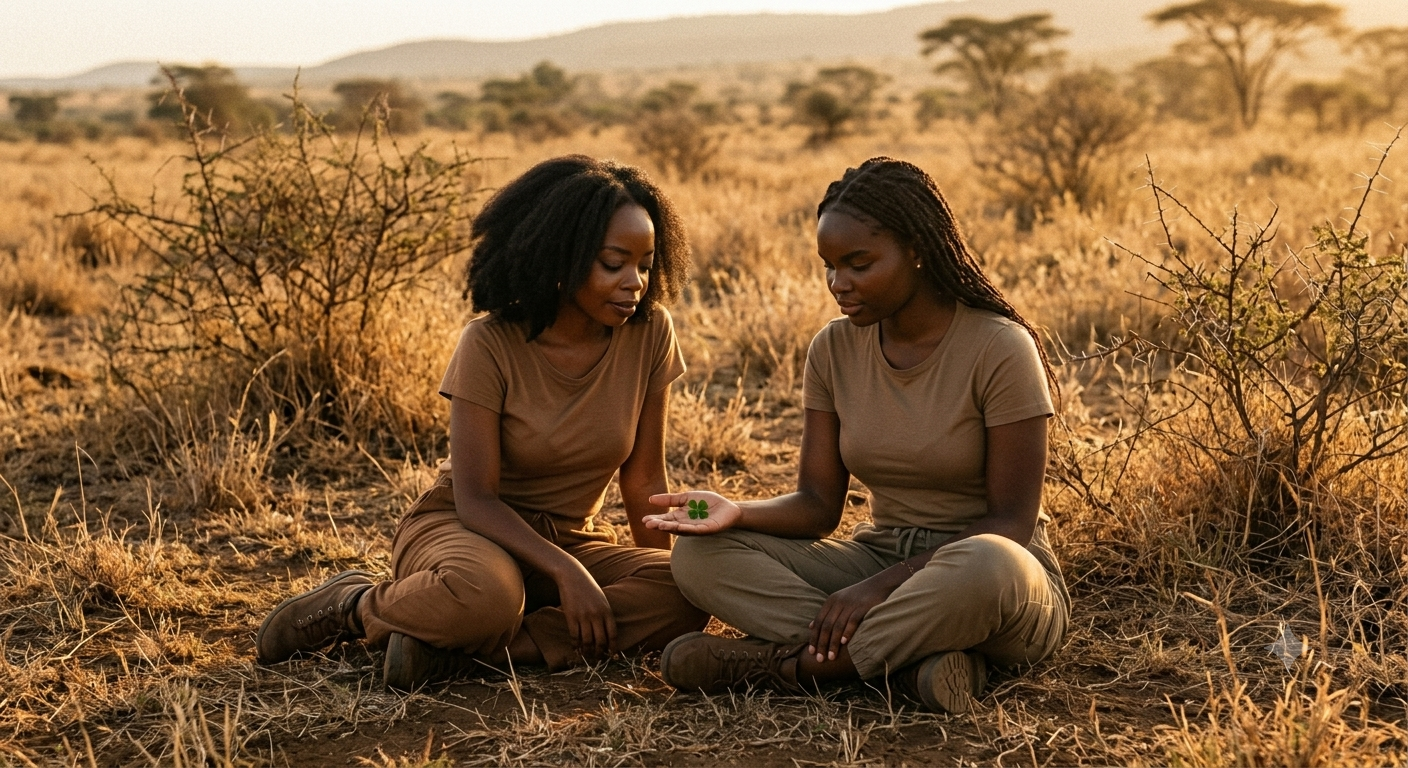
The fourth time the clover appeared, I was in the woods with Leah. A sister from the Berean community — and one of the people who holds this whole thing up, part of our Nnalolile Yvi Foundation. We were sitting in the way that women sometimes sit when the world has been particularly stupid — not dramatically, not falling apart, just lightly lamenting. Our failures. Our bad life. The specific comedy of being faithful women in a world that seems structurally indifferent to faith. We were not looking for anything. And there it was. Four leaflets. We both saw it. We both picked it up. We did not make speeches about it. Leah is in Canada now, where she always wanted to be, strong in her faith — the kind of strong that comes not from having been untested but from having been tested in full and arrived on the other side, not unscathed but standing. That is the testimony. Not the clover, exactly. What the clover kept doing to my attention.
In May of 2024 I was baptised. Thirty-one years old. I sneaked away from my grandmother’s place to do it — a grown woman slipping out like a teenager going to a party she was not supposed to attend, except the party was the water. The confession. The plunge. No announcement. No family formation photograph. Just me, and the brethren who had walked with me long enough to know I was ready, and whatever it is that happens when you go under and come back up. I was late, as usual. Or — as I have come to believe — exactly on time. Because the God I know does not operate on social schedules.
What came after was not a reward. It was a test — immersion therapy, the kind where the world puts you back into the exact conditions that once broke you, to find out whether anything has changed. In 2024 I took a job at a company — Muslim-dominated, professional on paper, and for a while genuinely fine. I was good at what I did. I enjoyed it. And then, gradually — the way things always happen gradually until they are not gradual at all — the environment shifted. The pressure. The expectation. The small daily transactions that added up to a single demand: conform, or be made uncomfortable until you do. I spoke up. Not with a grand speech or a legal filing. I did it the way I do most things — directly, clearly, in my own words, in my own time. Measures were taken. The environment improved. I was thanked for the courage. And then I resigned. They gave me a nice send-off, which I note not to commend them but because grace tends to appear in strange shapes, and I have learned not to ignore it when it does.
What followed was the High-Rise period — my second Tsavo experience. A hostile tenancy situation. The confiscation of belongings. The violation of space. The indifference of institutions. The particular cruelty of people who hold keys to your shelter and know you cannot afford to lose them. I had been here before, in a different form, in the years before the YVIX writing, before the water. The first time it drove me to a bathroom floor. This time I already knew the returning address. The doctrine that had gotten into my bones in childhood had not moved. I was not well — but I was not lost. Those are two different things, and I had finally learned to tell them apart.
I was not well — but I was not lost. Those are two different things, and I had finally learned to tell them apart.
I live alone now. This is not a complaint — it is a condition of my faith that I have come to understand as essential rather than incidental. You cannot depend on a brother’s exaltation when you are the only one in the room. Online fellowship is not the same as physical presence; I have tried both and I know the difference in my body, not just my theology. The sisters I write to, the ones I call when the week has been long, the encouragement exchanged in small messages that arrive at the precise hour they are needed — that is fellowship too, personal and earned, not institutional and assumed. And when I am genuinely stranded — spiritually, practically, in the ways that loneliness becomes logistical — there is always, with a consistency I can no longer attribute to coincidence, a brother who appears with a solution. Not because I asked. Not because the community dispatched him. Because God routes things through people when the people are paying attention, and some of them are.
I speak my mind in the meeting. I push back when elders misread the text, when doctrine is used to divide rather than gather, when someone recites scripture the way people recite a legal clause — accurately, fluently, and with no apparent awareness that it is supposed to mean something inside the body as well as outside the mouth. This gets me into arguments. It has always gotten me into arguments. I have made peace with this, mostly, because I have watched what happens to the people who do not push back: they end up performing a faith rather than living one, and eventually the performance exhausts them and they leave quietly, the way my mother left, the way my sister left — pulled away not by unbelief but by the accumulated weight of a community that confused agreement with unity. I do not want that for anyone. I especially do not want it for the people coming behind us who are still deciding whether this is worth their whole life.
What I learned about the faith of childhood, the faith absorbed rather than chosen: it worked. Not as protection. Not as a script. The doctrine did not prevent any of it — the bathroom floor, the hostile workplace, the high-rise. But when I was in the underground reading the wrong books, the doctrine was there, not as a judge, but as a returning address. When I had nothing left but a four-leaf clover and a sister who also had no answers, it was there as the ground under the ground. You cannot transmit that through correct formulation. What you can do is show someone how to read. How to look. How to listen. How to let the text be strange rather than managing its strangeness into doctrine. How to expect that God will use containers you have not pre-approved — a banned novel about children who never asked to be connected to history, a four-leaf clover in a bathroom, a Nairobi high-rise that turned out to be a second chance — because God has always been interested in working through the unexpected.
You know the story of Omelas. Everyone leaves eventually — those few who cannot live with what the happiness costs. They walk away into the dark, toward a city that is just a vague brightness on the horizon, and Le Guin says the place they go to is a place even less imaginable to most of us than the city of happiness. What I have come to believe is this: the ones who walk away are not heroes because they walked away. They become themselves — which is harder than being a hero — because they walked away alone. No committee voted on it. No doctrine specified the procedure. No one else’s spiritual schedule set the departure time. There is a version of religious life that is entirely Omelas. The happiness is real. The community is warm. The doctrines are correct, as far as they go. And in the basement, undiscussed, there is the agreement: you will not ask too many questions, you will not arrive at your own conclusions, you will repeat the formulations that have been approved and call it faith. I am not speaking of any particular community — I am speaking of a temptation that lives inside every community, including the one I love. Even careful readers can become comfortable readers. Even good doctrine can become a script. And when that happens the people who need it most — the ones on the edges, the ones whose mothers are outside and whose sisters are still wounded — those people do not come back. The faith that survives is the one you arrived at alone, in the dark, after the approved containers failed.
The disciples who walked with Jesus did not learn a set of doctrines and speak from a script. They fished badly until they didn’t. They fell asleep in Gethsemane. They asked, repeatedly, who was going to be greatest. One cut off a man’s ear. They ran away on the hardest night. One denied knowing Jesus three times before breakfast. And then they went and turned the world over. Not because they had finally gotten the doctrine right. Because the encounter was personal. Because they had been there, and they had seen what they had seen, and no one could tell them otherwise, and they had stopped needing anyone to.
Not you are lucky — but you are watched. Not God approves of your performance — but God is here in the underground with you, in the places that are not on any map.
I am not righteous. I have never been righteous. I am Atoto Atori, child of the clan, child full of stories. But I have a faith that is mine — not inherited, not performed, not scripted. Arrived at through the underground, through books given by strangers, through sisters who lamented in the woods and sent encouraging messages at the right hour, through brothers who appeared with solutions without being asked, through a God who kept showing up in the last place I was looking. My mother is still outside. My sister is still healing. The door remains open, as it always has, and no doctrine should ever be the thing that keeps them from walking back through it.
That is the whole story. That is the testimony.
We look. We listen. Most importantly, we learn something new — not from each other, but from the God who keeps appearing in the last place we were looking.